When customizing polarized sports sunglasses, many brands focus primarily on polarization performance, price, and lead times. Samples received from suppliers often look fine, yet large-scale production frequently reveals widespread issues with polarization effectiveness.
These problems rarely stem from “no polarization being applied.” Instead, they usually result from several easily overlooked details that were not fully confirmed and controlled in the early stages. For activities such as cycling, бег, рыбалка, and water sports, these details directly impact the end-user experience.
Drawing on years of industry experience, Julong outlines the most commonly neglected key points below and provides practical recommendations to avoid them.
Critical Factors in Polarized Sports Sunglasses
Polarized sports sunglasses include an additional optical film layer compared with regular sunglasses. The actual performance of the polarized lenses during customization depends on:
– Correct and consistent polarization axis orientation
– Proper matching of lens curvature
– Whether the assembly process introduces additional stress
– Adequate protection during transportation and storage
Any deviation in these areas can reduce the effectiveness of the polarization—or nearly eliminate glare-blocking performance at certain angles. Below we examine each of these key factors in detail.
1. Polarization Axis Control
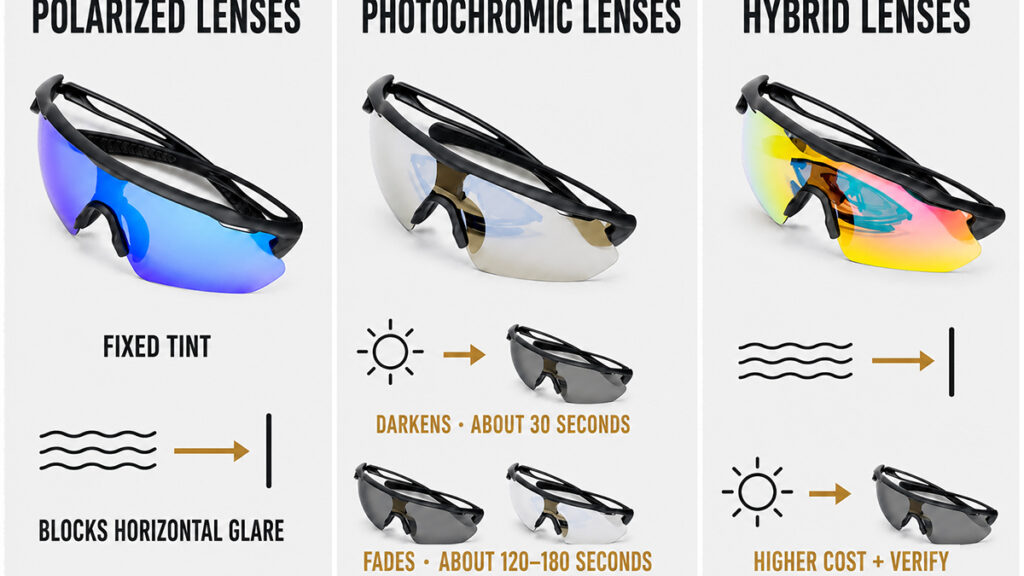
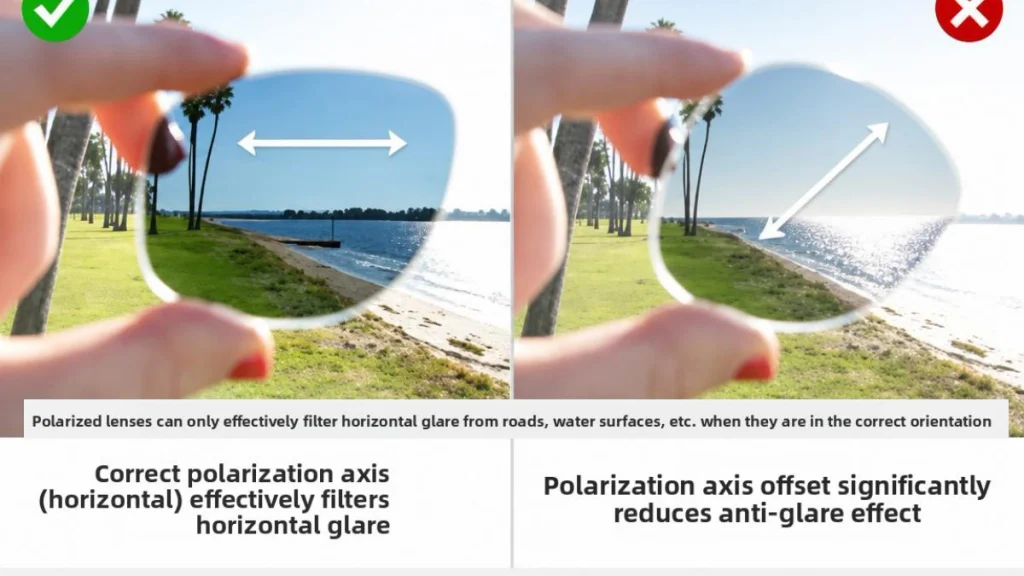
Polarized lenses only effectively filter horizontal glare (such as reflections from roads or water surfaces) when the axis is correctly oriented.
If the axis shifts during production or assembly, users often report that “the polarization is not noticeable” or that it “has no effect at certain angles.” This issue is especially noticeable in cycling and fishing scenarios.
A simple test: if you have two pairs of polarized sunglasses, overlap them and rotate one relative to the other—you will clearly see the difference in light transmission.
Julong’s Action Recommendation: Clearly define the polarization axis standards during the requirements confirmation stage and require the manufacturer to provide corresponding inspection documentation (polarization testing is mandatory for the relevant products).
2. Lens Curvature and Frame Matching
Sports sunglasses commonly use cylindrical or spherical lenses to deliver better wrap and field of view. Bending polarized lenses affects their optical performance.
If the lens curvature does not properly match the frame design, edge polarization can decrease, localized stress can cause distortion, or the lens may fail to seat fully after assembly.
Julong’s suggestion:
– Evaluate the actual match between lens curvature and frame during the design confirmation stage rather than relying solely on flat renderings.
– Fully discuss the potential impact of the frame design on polarization performance with the manufacturer before tooling to avoid major adjustments at the sample stage.
3. Assembly Stress Issues
Even when the lenses themselves meet polarization specifications, improper force or inaccurate positioning during assembly can introduce stress. This may reduce localized polarization performance or cause deformation over time.
Sports sunglasses often use flexible materials such as TR90, making stress control during assembly particularly important.
We are in agreement: Confirm whether the manufacturer has dedicated assembly and inspection processes specifically for polarized products.
4. Packaging and Transportation Protection
Polarized lenses are relatively more delicate. Improper packaging or compression during shipping can deform lenses, damage coatings, or impair polarization performance.
Many issues do not appear at the factory—they only become evident during logistics.
I think :Confirm the packaging solution separately rather than simply adopting the standard packaging used for regular sunglasses.
How These Details Affect Final Product Performance and After-Sales
When the above details are not properly controlled, common consequences include:
– Customer feedback that “polarization is not noticeable”
– Persistent glare at specific viewing angles
– Visible stress marks or lens deformation
– Increased returns and complaints
– Repeated communication with the factory regarding rework
These issues are often difficult to fully detect at the sample stage but surface during mass production and real-world use, increasing both communication effort and time costs.
How Julong Helps Prevent These Issues Early
Julong Eyewear is an OEM/ODM manufacturer specializing in sports eyewear. Our product range includes sports sunglasses and cycling glasses that use PC polarized lenses. Quality control for relevant products covers polarization testing, UV400 testing, impact resistance testing, and other items.
In customization projects, we place particular emphasis on polarization axis consistency, lens-to-frame matching, assembly stress control, and specialized packaging protection for polarized products. This approach reduces the risk of optical performance issues after mass production. Specific solutions are adjusted according to the brand’s target use scenarios and product positioning.