Choosing between OEM (Original Equipment Manufacturing / Custom Build) and ODM (Original Design Manufacturing / Private Label) determines your production timeline, tooling requirements, and brand differentiation:
- Choose ODM (Private Label) if you want rapid market entry (30–45 days), need no custom tooling development, and want to test customer demand across multiple sports categories with flexible starting volumes (standard 300 pcs/style).
- Choose OEM (Custom Manufacturing) if you own proprietary frame geometry, patented lens-swapping mechanisms, or specialized Over-The-Glasses (OTG) ergonomics. This path requires a dedicated tooling development cycle (60–75 days) and grants 100% exclusive intellectual property (IP).
- The Strategic Industry Approach: Many growing brands use a hybrid strategy—launching proven ODM styles across multiple colorways to establish sales velocity, while developing proprietary OEM molds for their flagship performance models.
What Is Sports Sunglasses OEM?
OEM (Original Equipment Manufacturer) is a fully customized production model where the eyewear factory manufactures frames and lenses strictly according to your proprietary CAD designs, technical drawings, and material specifications.
Client CAD / Tech Pack ➔ 3D SLA Prototyping (5–7 Days) ➔ Tooling Fabrication (25–30 Days) ➔ Golden Sample Sign-Off ➔ Mass Production (30 Days) ➔ Exclusive Finished ProductThe 5-Step OEM Process
- Design & Tech Pack Handoff: Submit 2D/3D CAD files (STEP/IGES), wrap curvature (Base 6 to Base 8), Pantone color references, rubber temple details, and lens specifications (e.g., Category 0–3 photochromic or TAC 1.1mm polarized).
- DFM Review & Rapid Prototyping: Optical engineers conduct Design for Manufacturability (DFM) analysis on draft angles and parting lines. A 3D resin or CNC prototype is provided in 5–7 days for athlete fit testing.
- Steel Tooling Fabrication: Precision steel injection molds are machined for the frame body and co-injected rubber temple tips (25–35 days).
- Pre-Production Golden Sample: A counter-sample with final coating, laser branding, and lens tint is signed off before mass production begins.
- Mass Production & Quality Control: Automated frame injection, multi-stage barrel tumbling polish, cleanroom lens assembly, and lot-level impact verification.
When to Choose OEM
- You have proprietary aerodynamic frame geometry, patented lens-lock mechanisms, or custom ventilation ports.
- You need exclusive design rights and registered design patent protection for retail placement.
- Your project timeline accommodates tooling lead time and pre-production validation.
What Is Sports Sunglasses ODM?
ODM (Original Design Manufacturer), or Private Label, allows brands to select proven frame silhouettes from the factory’s existing mold catalog, customizing colors, lens treatments, branding, and packaging.
Factory Mold Catalog ➔ Material & Lens Selection ➔ Custom Logo & Colorways ➔ Counter-Sample (5–7 Days) ➔ Mass Production (30–45 Days)The 5-Step ODM Process
- Catalog Selection: Choose from 500+ active sports frame molds (cylindrical cycling shields, Base-8 wrap running sunglasses, frameless baseball guards, or floating watersports styles).
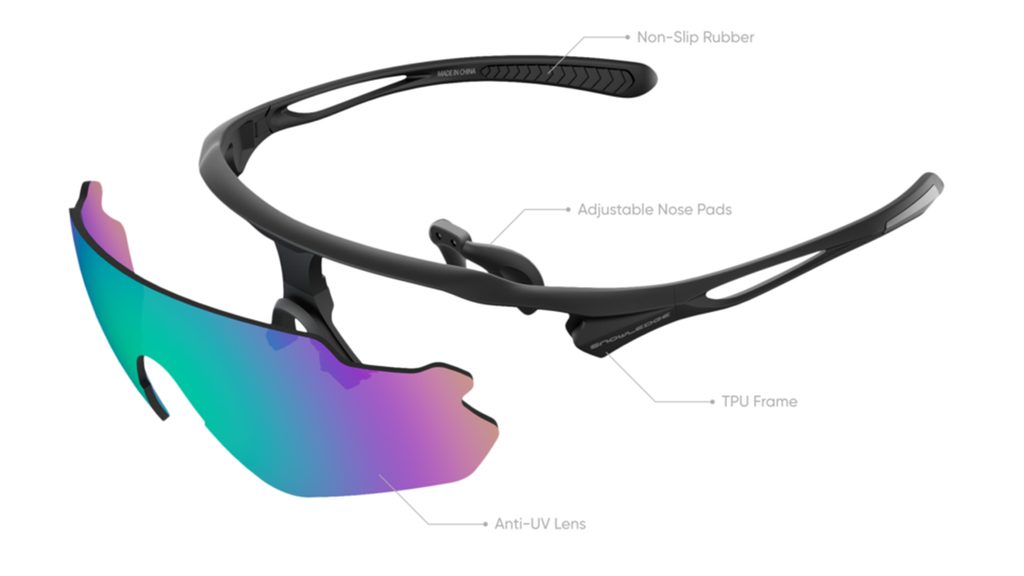
- Performance Configuration: Select frame resin (e.g., Swiss EMS TR90), anti-slip nose pad textures, and optical lens options (polarized, photochromic, or Revo mirror coatings).
- Branding & Packaging: Apply laser-etched lens logos, pad-printed temples, molded badges, and custom packaging (EVA hard cases, microfiber pouches, test cards, retail boxes).
- Physical Sample Confirmation: Receive counter-samples in 5–7 working days for evaluation.
- Streamlined Production: Because existing tooling is utilized, production completes and ships in 30–45 days.
When to Choose ODM
- You need rapid speed-to-market ahead of seasonal athletic cycles (cycling, marathon, or water sports seasons).
- You want to eliminate mold fabrication lead times and tooling development requirements.
- You plan to launch 4–8 colorways across an agile product line with flexible minimum quantities (300 pcs/style).
| Evaluation Parameter | OEM (Custom Manufacturing) | ODM (Private Label / Catalog) |
| Design Ownership & IP | 100% Brand Proprietary (Exclusive design patents) | Factory-Owned Mold Base (Brand owns branding/packaging IP) |
| Tooling Requirement | Dedicated mold tooling required | Zero tooling required (Uses active molds) |
| First-Order Lead Time | 60–75 Days (Tooling: 30d + Production: 35d) | 30–45 Days (Ready for immediate scheduling) |
| Re-Order Lead Time | 30–35 Days | 25–35 Days |
| Standard Minimum Order (MOQ) | 600–1,200 pcs / style | 300 pcs / style (100 pcs / colorway) |
| Customization Depth | Complete freedom in geometry, hinges, and vents | Frame colors, lens optics, temple rubber, and branding |
| Best Fit For | Patented innovations, funded brands, pro teams | Emerging brands, Amazon/Shopify stores, sports clubs |
Frame Materials & Optical Lens Technologies
Sports eyewear must withstand intense UV exposure, sweat acidity, heavy vibration, and accidental impact. Selecting certified materials ensures long-term product durability and user safety.
1. Frame Materials Comparison
MaterialDensity & WeightElasticity & MemoryImpact ResistancePrimary Sports ApplicationSwiss EMS TR90Ultra-Light (1.14 g/cm³)Superior (Shape Memory)HighCycling, Running, Pickleball, BaseballPolycarbonate (PC)Medium (1.20 g/cm³)Low (Rigid)HighEntry-Level Promotional Sports EyewearTPX (Polymethylpentene)Ultra-Light (0.83 g/cm³)ModerateHighFloating Watersports / Fishing Eyewear
- Swiss EMS Grilamid TR90: Delivers high flexibility, sweat-oil resistance, and thermal stability (-30°C to +80°C), preventing frame warping in extreme environments.
2. Optical Lens Options
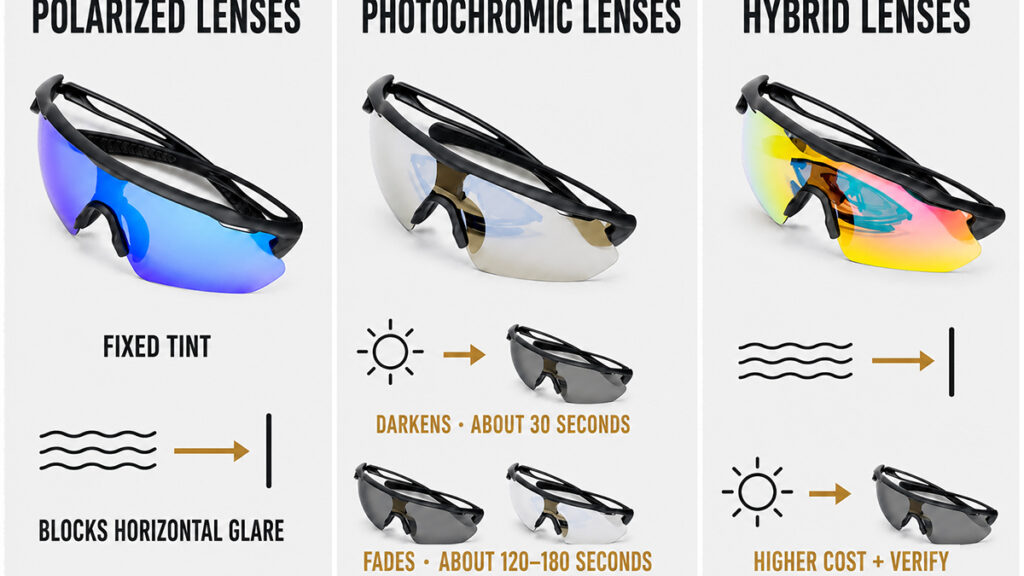
- TAC 1.1mm Polarized Lenses: Multi-layer composite with core PVA polarizing film, eliminating surface glare for fishing, rowing, and driving.
- Polycarbonate (PC) Shatterproof Lenses: High-velocity impact resistance designed for ball sports (pickleball, baseball, tennis) to protect against eye injury.
- Photochromic Transition Lenses (Cat. 0 to Cat. 3): Automatically adjusts from clear tint in overcast conditions to dark tint under intense UV light within 60 seconds.
- Full Revo Multi-Layer Mirror Coating: Vacuum-deposited dielectric coatings that reduce glare and optimize contrast across varied terrains (e.g., trail running, road cycling).
- Hydrophobic & Oleophobic Coatings: Repels sweat, water droplets, and fingerprints for clear visibility during intense training.
The Hybrid Sourcing Strategy
Many successful performance brands combine both manufacturing models into a structured 3-phase roadmap:
- Phase 1: Catalog Speed & Market Validation (ODM)
Launch 2–3 proven sports styles across 3–4 colorways with manageable starting quantities. Test consumer preferences for fit, lens tint, and ventilation. - Phase 2: Developing a Proprietary Flagship (OEM)
Use real customer feedback to design a custom hero style with proprietary features (e.g., custom brow ventilation, unique wrap geometry). Secure design patents to protect your brand equity. - Phase 3: Balanced Product Portfolio
Maintain proprietary OEM flagship models for brand distinction alongside responsive ODM styles for seasonal color refreshes.
5 Sourcing Questions Before You Place an Order
- What is your target launch date?
- Under 45 days: Select ODM.
- 60–90+ days: Select OEM.
- Are CAD drawings and tech packs finalized?
- Concept phase: Use ODM or request factory DFM engineering support.
- Completed 3D files: Proceed to OEM.
- Do you require proprietary mechanical features?
- Standard sports usage: ODM covers most performance needs.
- Patented lens switch / unique frame geometry: OEM is required.
- What are the target market compliance standards?
- Confirm that your supplier provides lot-level test documentation (e.g., FDA impact compliance, ANSI Z80.3, CE ISO 12312-1) prior to production.
- How will your product line differentiate?
- Build differentiation through custom pantone frame matching, multi-layer Revo coatings, and dedicated retail packaging suites.
Common Sourcing Misconceptions
- Misconception 1: “ODM eyewear means lower quality.”
- Fact: ODM refers to mold ownership, not material grade. An ODM frame made with genuine Swiss EMS TR90 and optical-grade polarized lenses follows the same injection, polishing, and inspection standards as an OEM product.
- Misconception 2: “Photochromic lenses react too slowly for sports.”
- Fact: High-grade optical monomer photochromic lenses transition rapidly under direct UV radiation, offering reliable contrast shifts between open sunlight and shaded areas.
- Misconception 3: “ODM products cannot achieve brand distinction.”
- Fact: Distinct brand identity is established through proprietary colorway curation, specialized lens coatings, customized rubber accents, laser logos, and branded packaging.
Testing & Regulatory Compliance Standards
Performance eyewear must satisfy destination-market regulations to clear customs and ensure user safety:
- United States:
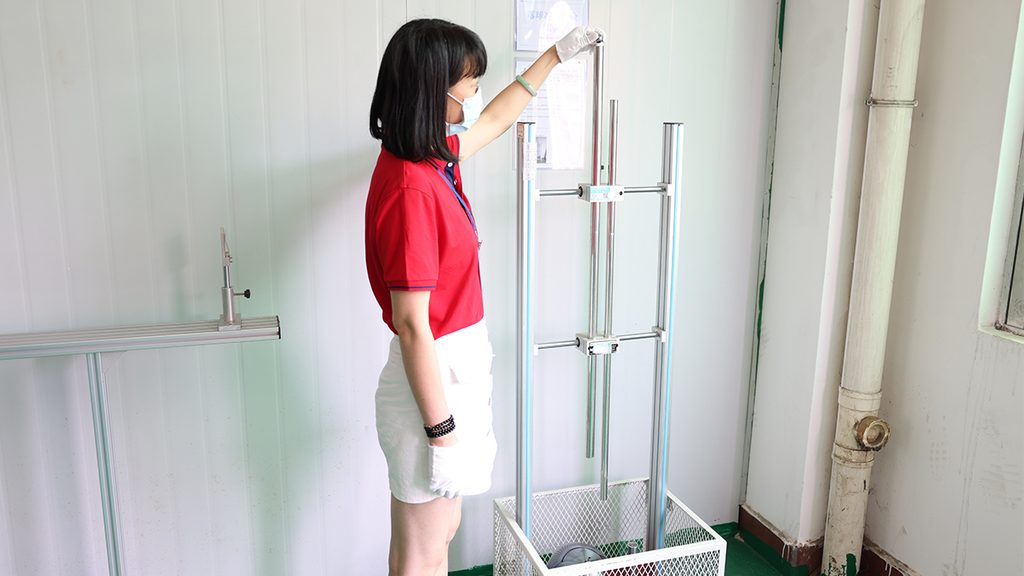
- FDA 21 CFR 801.410 (Drop-Ball Impact Resistance): Lenses must withstand the impact of a 5/8-inch steel ball dropped from 50 inches without fracturing. Each export lot must be accompanied by a certified test report.
- ANSI Z80.3: Standards for non-prescription eyewear optical quality and UV400 attenuation.
- European Union & United Kingdom:
- ISO 12312-1:2022 / EN ISO 12312-1:2013+A1: General-use sunglass safety and optical clarity standards.
- CE & UKCA Declaration of Conformity (DoC).
- Australia & New Zealand:
- AS/NZS 1067.1:2016: Mandatory UV radiation transmittance categories (Cat. 0 to 4).
Manufacturing Capabilities at Julong Optical
Julong Optical (聚隆光学) provides end-to-end manufacturing solutions for sports and lifestyle eyewear brands worldwide:
- 500+ Active Sports Molds: Immediate access to cylindrical shield lenses, Base-8 wrap frames, and OTG prescription sports designs.
- In-House Tooling & Prototyping: 3D SLA prototyping in 5–7 days; precision steel mold creation in 25–30 days.
- Certified Materials: 100% genuine Swiss EMS TR90 granules, shatterproof optical polycarbonate, TAC 1.1mm polarized films, and Cat. 0–3 photochromic lenses.
- Flexible Starting Quantities: ODM private label starting from 300 pcs/style (100 pcs/colorway); OEM custom production from 600–1,200 pcs.
- In-House Testing Facility: Automated UV400 spectrophotometer verification, 21 CFR 801.410 drop-ball testing, and hinge fatigue testing (20,000+ cycles).
- Private Label Customization: Laser etching, pad printing, custom metal badges, EVA cases, microfiber pouches, and retail packaging.
Frequently Asked Questions (FAQs)
Q1: What is the typical development timeline for custom OEM sports sunglasses?
A: Custom OEM tooling generally takes 25 to 35 days, followed by 5–7 days for prototype/sample approval. Once the golden sample is approved, mass production typically takes 30 to 35 days.
Q2: What is the minimum order quantity (MOQ) for ODM private label sports sunglasses?
A: Standard private-label ODM MOQ is 300 pieces per model, with the option to split the order across 3 colorways (100 pcs/colorway).
Q3: Who owns the design intellectual property (IP) in OEM vs. ODM?
A: In OEM, the client owns 100% of the design blueprints, CAD models, and tooling rights under strict NDA terms. In ODM, the factory retains ownership of the base mold, while the client owns all trademarks, custom logos, color specifications, and packaging designs.
Q4: Can I mix polarized, photochromic, and Revo lenses in one ODM order?
A: Yes. Within a 300-piece ODM order, you can assign different lens technologies across each 100-piece colorway (e.g., 100 pcs Polarized, 100 pcs Revo Mirror, and 100 pcs Photochromic).
Q5: What documentation is required for U.S. customs clearance?
A: U.S. imports require an official FDA 21 CFR 801.410 Drop-Ball Impact Test Certificate corresponding to the production lot, alongside documentation verifying ANSI Z80.3 optical and UV400 compliance.