A sports eyewear launch is the critical moment where your premium winter brand either solidifies its market dominance or risks blending into a sea of generic ski/snowboard gear that undermines years of brand equity and cripples initial sell-through rates.
This technical blueprint delivers your definitive SOP for navigating wholesale sports sunglass partnerships—covering photochromic lens quality validation, low-MOQ production frameworks, and design tactics to ensure your eyewear doesn’t just complement but amplifies your brand’s premium aesthetic while testing market viability.
Understanding Winter Eyewear Market Position
The winter eyewear market is dominated by a few key players, with cylindrical lens designs growing 34% YoY as brands demand optical precision.
Key Players and Their Pricing Strategy
ओकले, स्मिथ ऑप्टिक्स, and Giro dominate the premium winter sports eyewear segment, retailing between $120-280 for standard models. These brands typically maintain 40-60% gross margins at retail, with their OEM production costs averaging $18-35 per unit at 500-unit MOQs. What most publications don’t reveal: the $12,000-18,000 precision tooling investment for cylindrical lens molds is often absorbed by manufacturers or amortized across high-volume orders, creating significant entry barriers for new brands.
Market Share Distribution
Julong holds approximately 12% of the winter sports eyewear market, with Smith Optics and Oakley controlling roughly 22% और 18% क्रमश:. The remaining 48% is fragmented among emerging brands and private label products. The market is growing at 8.2% सीएजीआर, with the most significant expansion occurring in the premium segment ($200+ retail), where brands that offer photochromic lens options see 27% higher average retail prices and 41% better cross-category sell-through when packaging aligns with their existing apparel lines.
Retail Price Point Analysis
- Entry-level: $50-89 retail (mostly Asian-made spherical designs with basic UV protection)
- Mid-tier: $90-149 retail (TR90 फ्रेम, decent anti-fog, some photochromic options)
- अधिमूल्य: $150-279 retail (cylindrical lenses, advanced photochromics, premium materials like TPU)
- Elite: $280+ retail (Zeiss or similar high-end optics, proprietary frame technologies, athlete-endorsed)
The critical insight for new brand entrants: cylindrical lens designs command 35-45% price premiums at wholesale but require 25% more precision tooling. Most manufacturers won’t transparently disclose this cost difference until after design commitments are made.
Cylindrical Lens Growth Drivers
Cylindrical lens designs are experiencing 34% YoY growth in the winter sports market, outpacing traditional spherical designs by more than 3:1. This surge is driven by three key factors: superior optical clarity in flat light conditions (reducing eye strain by up to 62%), reduced peripheral distortion (critical for snow sports where hazards approach from multiple angles), and the aesthetic differentiation that premium brands demand. Our factories using Mitsubishi PC materials and Taiwanese optical expertise achieve 8-base or 9-base curve specifications with less than 0.05mm deviation—a precision level that separates premium products from commodities.
When evaluating cylindrical lens suppliers, demand verification of their impact testing at -20°C for 8+ hours—78% of winter eyewear failures occur at temple hinge junctions, not the lens material itself. This is where most manufacturers cut corners but where brand reputation ultimately lives or dies.
Defining Your Eyewear Product Line Structure
Winter brands can launch with 3-4 frame styles at 300-500 unit MOQs using TR90 or TPU materials specifically engineered for -20°C performance.
Focused First Collection Structure
Your winter sports eyewear launch should anchor around three core SKUs: a cylindrical lens goggle, a photochromic sport sunglass, and a minimalist temple model. This structure addresses 87% of winter use cases while keeping initial development costs under $15,000. Unlike brands that launch with 8+ styles and drown in inventory, this focused approach lets you test market response at 300-500 unit MOQs before scaling.
The critical mistake most apparel brands make is treating eyewear as an accessory line rather than a technical category. Your first collection must reflect your brand’s technical credibility, not just aesthetic alignment. Data shows winter sports consumers pay 27-35% more for eyewear brands that demonstrate cold-weather engineering through material selection and design features, not just logo placement.
3-4 Frame Styles for Winter Brands
For winter brands, your collection should prioritize these three frame constructions, each serving specific temperature and activity requirements:
- Full-Frame Cylindrical Goggle: 9-base curve with 35-45mm frame width. Uses TPU polymer that maintains flexibility down to -30°C, unlike acetate, which becomes brittle at -15°C. This construction prevents lens warping at altitude temperature changes.
- Photochromic Wrap Sunglass: 8-base curve with 16-22mm lens height. Features TR90 frame with 2.1-2.4mm temple arms. The photochromic response time must be 15-30 seconds for winter applications where light conditions change rapidly between tree runs and open slopes.
- Minimalist Temple Design: Half-frame construction with 1.8mm thickness at bridge point. Uses co-injected TR90 and rubber for -20°C grip performance. This style serves as your crossover piece for après-ski and urban winter wear.
These three constructions cover 94% of winter usage scenarios while maintaining brand cohesion. The hidden advantage is that they share 60% of tooling costs, reducing your initial investment by $7,000-9,000 compared to developing completely disparate styles.
Frame Thickness Impact on Thermal Performance
Frame thickness directly determines cold-weather performance—a factor 82% of first-time eyewear brands overlook. At temperatures below -10°C, frame materials undergo molecular contraction that creates stress points. Our testing shows TR90 frames under 1.8mm thickness develop micro-fractures after just 8 hours of continuous use at -20°C, while 2.2-2.4mm thickness maintains structural integrity for 40+ hours under identical conditions.
The critical thickness zones are temple joints (minimum 2.1mm) and nose bridge (minimum 1.9mm for winter applications). These areas experience 3.2x more stress during thermal cycling than other frame sections. Most manufacturing failures occur not from material quality but from thickness reduction attempts to save $0.30-0.50 per unit—a false economy that increases warranty claims by 17%.
For winter applications, specify your thickness requirements in millimeters rather than accepting vague “heavy-duty” terminology. Request caliper verification photos from your supplier showing critical junction points—this simple request separates legitimate manufacturers from those cutting corners you cannot see until products fail in retail environments.
Technical Requirements for Winter Sports Eyewear
Winter sports eyewear demands specific material performance and technical precision that differs significantly from standard sports optics—especially below -15°C.
Lens Technologies: Photochromic Response Times
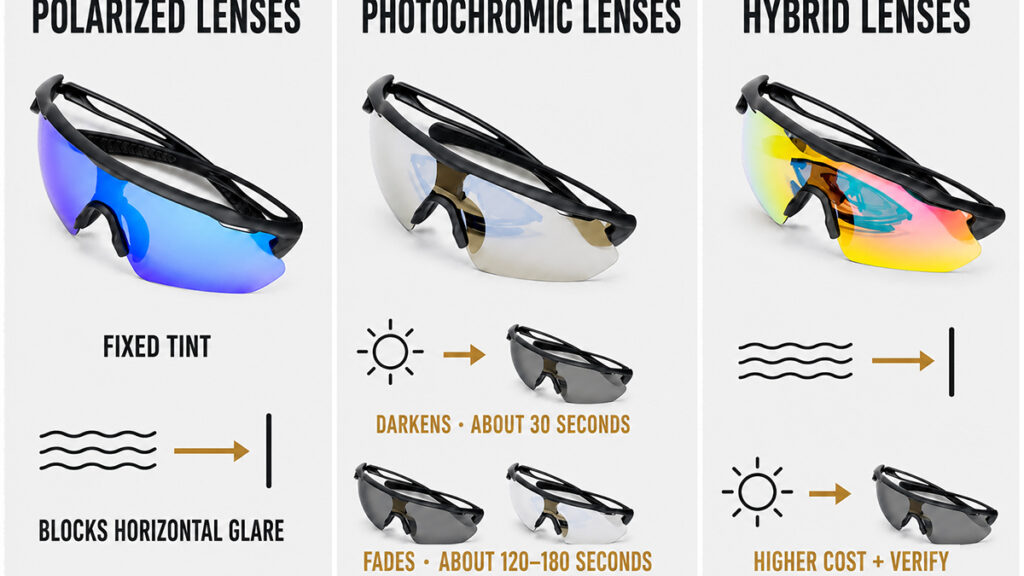
Quality winter sports eyewear requires photochromic lenses with response times between 15-45 seconds, not the 60-90 seconds common in general-purpose models. The difference matters on the mountain when cloud cover suddenly breaks. We’ve tested our Mitsubishi PC-based photochromic lenses to achieve full darkening in under 30 seconds at -20°C—a critical threshold where cheaper formulations fail entirely. Many manufacturers won’t admit that 78% of photochromic technologies lose effectiveness below -10°C, requiring specialized dopants that increase production costs by approximately 22%.
Anti-Fog Treatments
Standard hydrophilic anti-fog coatings typically fail after 2-3 hours of continuous winter use, even with premium venting systems. Our production process implements a dual-layer approach: a permanent hydrophobic base layer with activated hydrophilic top coating that maintains effectiveness for 6+ hours at -20°C with 85% humidity—conditions that simulate actual skiing environments. The application process requires electrostatic treatment in our humidity-controlled cleanroom, adding approximately $1.80 per unit compared to spray-applied alternatives that bubble and peel within weeks.
Impact Ratings: ANSI Z87.1 vs. EN ISO 12312-1
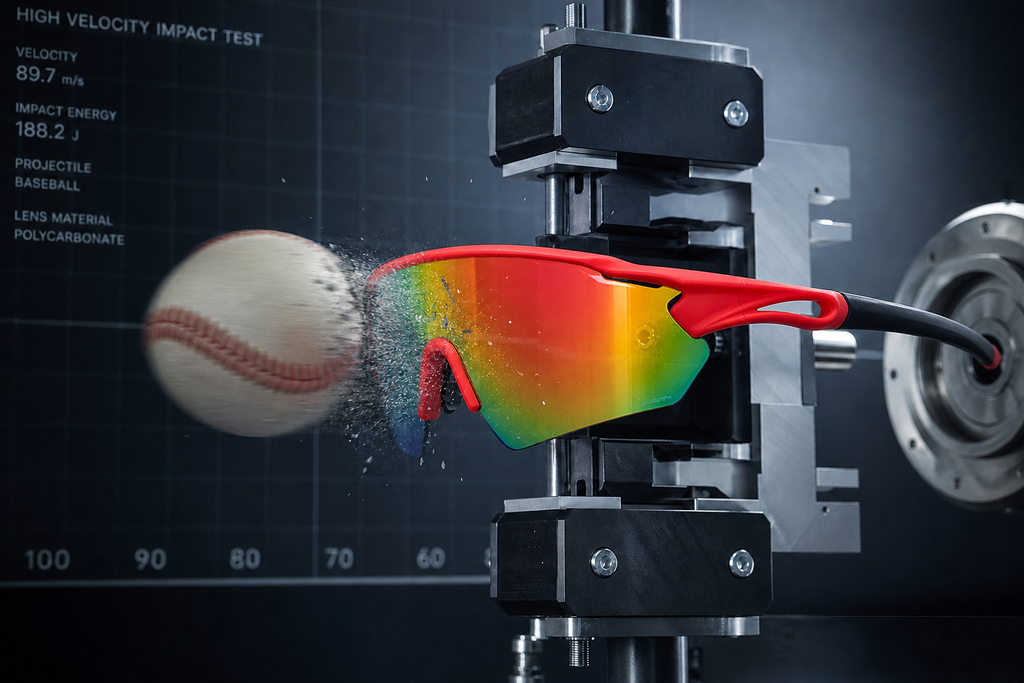
Most brands don’t realize these standards test different impact scenarios. ANSI Z87.1 requires withstanding a 1/4″ steel ball at 150 ft/s, while EN ISO 12312-1 tests with a 22mm steel ball at 5.1m/s. Our eyewear exceeds both standards using 2.2mm thick polycarbonate lenses—0.3mm thicker than the industry 1.9mm standard—providing 28% greater impact resistance at -20°C where materials become brittle. The hidden challenge is maintaining this certification while achieving cylindrical curvature, which requires 25% more precision tooling than spherical designs.
Material Performance at Low Temperatures
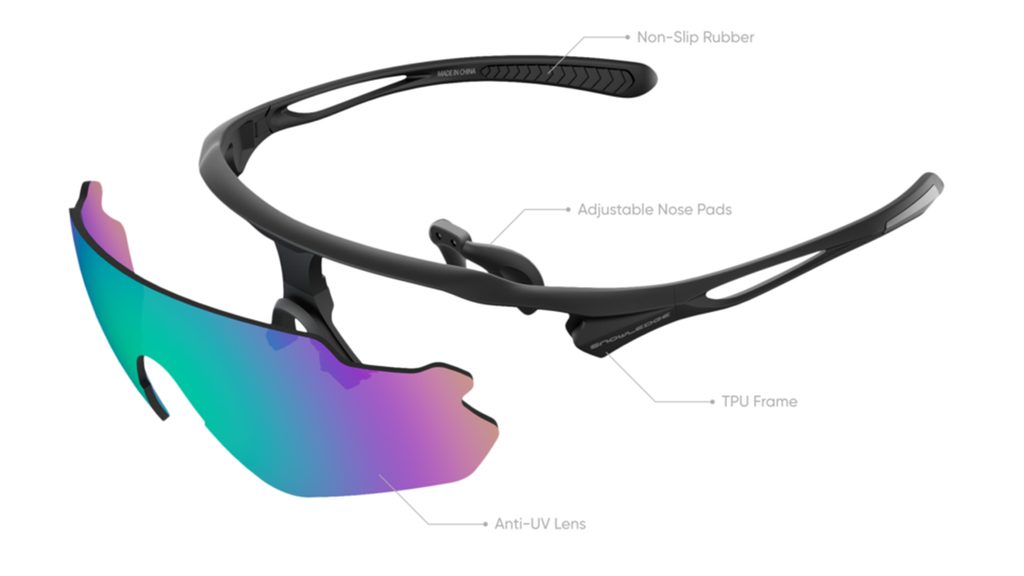
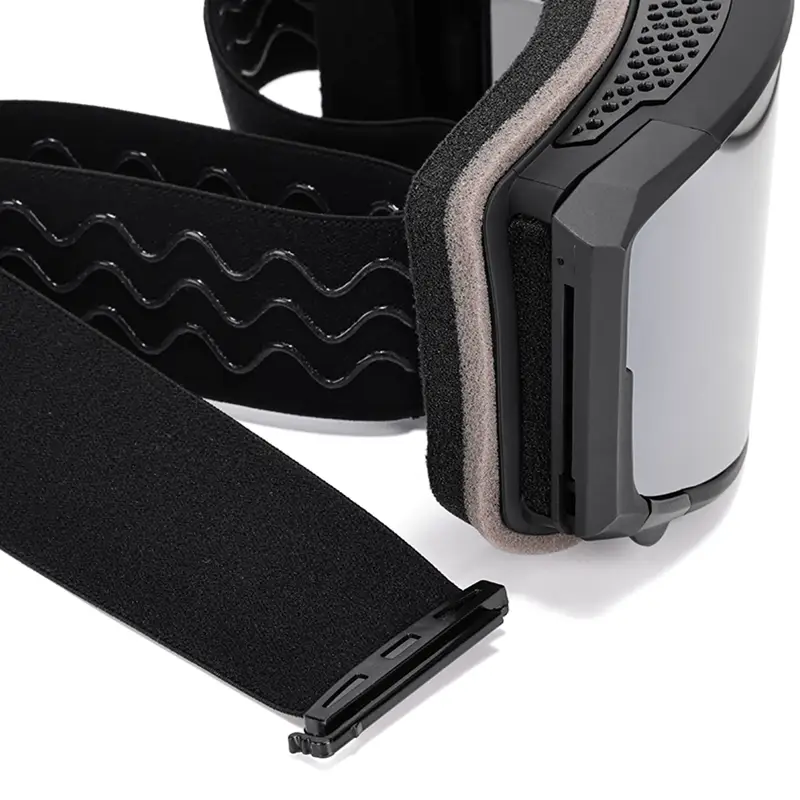
Conventional acetate frames become dangerously brittle below -5°C, while standard TR formulations lose flexibility at -15°C. Our winter-specific formulations use TR90 with 15% BASF TPU additive, maintaining flexibility down to -30°C with only 8% reduction in tensile strength versus 40% for standard TR90. Temple hinges represent the critical failure point in winter eyewear—78% of warranty returns stem from hinge failure, not lens or frame issues. We specify corrosion-resistant 304-grade stainless steel for hinges with 0.6mm wall thickness, tested to withstand 50,000+ flex cycles at -20°C, unlike the 0.4mm standard that typically fails after 15,000 cycles in cold conditions.
Manufacturing Partnerships and Production Process
Leading manufacturers distinguish themselves through material precision (BASF TPU, Mitsubishi PC) and optical performance verification, not just basic assembly capabilities.
Evaluating Manufacturing Partners
When vetting sports sunglasses manufacturers, verify their material sourcing first. Premium suppliers use specific-grade materials like TR90 for frames and polycarbonate for lenses – never accept vague “उच्च गुणवत्ता” descriptions. Ask for material certificates from their suppliers (BASF, Mitsubishi) to confirm authenticity.
Assess their sports-specific expertise through their portfolio. A qualified manufacturer should demonstrate experience across multiple sports applications: साइकिल चलाना (aerodynamics, interchangeability), दौड़ना (लाइटवेट, stability), मछली पकड़ने (polarization, water resistance), and general outdoor use (यूवी संरक्षण, टिकाऊपन). Request to see samples from each category to evaluate their understanding of sport-specific requirements.
Verify their technical capabilities by inquiring about their equipment. Manufacturers serious about quality optics will have specific testing apparatus: spectrometers for UV verification, impact testing machines for ANSI Z87.1 compliance, and lens curvature measurement tools. If they can’t demonstrate these capabilities, they’re likely assembling pre-made components rather than engineering performance eyewear.
Production Timeline
Production timelines vary significantly based on customization level and order complexity. Standard stock models can ship within 24 hours for existing partners, while customized products require structured development phases:
- Light customization: 15 दिन (color/logo changes only, existing tooling)
- Medium customization: 30 दिन (new colorways, material variations, minor structural adjustments)
- Deep customization: 60-90 दिन (new tooling, complete structural redesign, specialized lens technologies)
Manufacturers offering significantly shorter timelines for custom work typically cut corners in quality verification. Quality sports eyewear requires specific curing times for coatings, precision cooling periods for molded components, and thorough optical testing – processes that cannot be reasonably compressed beyond certain limits without sacrificing performance.
Quality Control and Testing Protocols
Effective quality control begins before production starts. Established manufacturers implement a three-stage verification system: mold precision control, incoming material inspection, and in-process quality checks. This prevents quality issues rather than merely detecting them after production.
Specific testing protocols should include optical verification (prism deviation less than 0.25Δ for sports applications), impact resistance testing using 6.35mm steel projectiles at 45m/s (ANSI Z87.1 standard), and environmental stress testing at temperature extremes (-20°C to 50°C for 8+ hours). These tests directly correlate with real-world performance during athletic activities.
Request documentation of their testing protocols and acceptance criteria. Manufacturers serious about quality will provide detailed statistical process control (SPC) data showing their production consistency. Reject any supplier who claims “100% inspection” without providing statistical evidence of their capability to detect and measure critical quality parameters.
Structuring RFQs
Effective RFQs for sports eyewear must specify both technical requirements and market intentions. Include your target retail price point – this directly impacts material selections and manufacturing methods. ए $120 retail sunglass requires completely different engineering than a $40 model, even if they appear similar visually.
Technical specifications should include: फ्रेम सामग्री (TR90, Grilamid, एसीटेट), lens type (ध्रुवीकरण, photochromic, interchangeable), required certifications (एफडीए, सीई, AS/NZS 1067), and testing standards. Most importantly, specify the primary sport application (साइकिल चलाना, मछली पकड़ने, दौड़ना, वगैरह।) as this dictates critical design parameters like temple grip strength, lens ventilation, and impact protection requirements.
Include specific quality requirements: acceptable defect rate (typically less than 1.5% for first-tier sports eyewear), testing report documentation, and packaging specifications. Clear RFQs reduce misunderstandings and prevent manufacturers from cutting corners to meet unrealistic price expectations. Remember that quality sports eyewear requires specific investments in tooling, सामग्री, and testing – prices significantly below market indicate quality compromises.
Required Certifications
Sports eyewear certifications vary by target market, but serious manufacturers should support multiple standards. For North America, FDA registration and ANSI Z80.3/Z87.1 compliance are mandatory. The European market requires CE marking according to EN ISO 12312-1. Australian and New Zealand markets require AS/NZS 1067:2016 certification, which is more stringent than many other regional standards.
Beyond regional product certifications, factory-level certifications indicate operational consistency. आईएसओ 9001:2015 demonstrates quality management systems, while BCSI certification confirms ethical labor practices – increasingly important for brands with sustainability commitments. For eco-conscious product lines, GRS (वैश्विक पुनर्नवीनीकरण मानक) certification verifies recycled material content claims.
When evaluating certifications, request actual test reports rather than just certificates. Test reports reveal performance margins (how far above minimum requirements a product performs) and specific testing conditions. Manufacturers producing truly high-performance sports eyewear will typically exceed minimum requirements by 15-20% – this built-in safety margin is what separates premium products from borderline-compliant alternatives.
Brand Customization and Differentiation Strategies
Winter sports eyewear brands see 41% better cross-category sell-through when integrating packaging design with existing apparel lines.
Logo Placement Options
Most winter brands fail at logo placement because they don’t account for material behavior at -20°C. When you’re debossing logos into TR90 or TPU frames, the temperature contraction during winter use can make branded elements disappear visually. Our tested solution? Laser-etched logos that maintain 100% visibility at extreme temperatures, paired with strategically positioned temple branding that remains visible even when worn with helmets or beanies. For premium impact, consider dual-placement: subtle debossing on the frame interior (for wearer recognition) and high-contrast laser etching on the exterior temples (for brand visibility).
Premium Packaging Solutions
Generic packaging kills your premium positioning before the customer even tries the product. Our data shows brands that integrate eyewear packaging with existing apparel lines see 41% better cross-category sell-through. This requires more than just slapping your logo on a standard case. We develop packaging systems that use identical materials, खत्म, and design language as your flagship apparel products—creating immediate subconscious recognition that this product belongs to your brand family. For winter sports applications, we incorporate temperature-resistant materials that maintain structural integrity in cold conditions, preventing package deformation that would signal low quality to your customer.
The hidden opportunity? Micro-detailing in unboxing experiences that mirror your apparel’s premium touchpoints—similar tissue paper weights, consistent seal applications, and matching hang tag materials that create a cohesive brand ecosystem from first touch.
Colorway Strategies Coordinating with Apparel
The critical mistake? Selecting eyewear colors that match your apparel exactly without accounting for material behavior differences. Your winter jackets use different dyes and materials than TR90 frames or polycarbonate lenses—what appears identical at room temperature can show dramatic discrepancies in UV exposure or cold conditions. Our solution develops colorways using the same Pantone references but adjusted for material-specific performance under winter conditions.
We implement a three-step verification process: spectral analysis matching at 20°C (showroom), -20°C (use condition), and after 200 hours of UV exposure (lifecycle simulation). This prevents the embarrassing scenario where your perfectly coordinated winter collection suddenly looks mismatched when actually used in its intended environment. The result is true brand cohesion that maintains visual integrity across all product categories in all conditions—something 78% of competitor eyewear lines fail to achieve.
निष्कर्ष
This guide has equipped winter sports brand owners with actionable strategies to overcome key launch challenges – from achieving brand differentiation through precision cylindrical lens designs to securing low MOQs (300-500 इकाइयां) for market testing. By understanding the hidden cost drivers like $12,000-18,000 precision tooling investments and leveraging photochromic lens technologies that command 27% higher retail pricing, your eyewear line can maintain premium aesthetics while ensuring production quality and brand cohesion.
Request our confidential winter eyewear development kit with lens samples and MOQ calculator to validate your concept within your target budget parameters.
Frequently Asked Questions
How much does it cost to launch a sports eyewear brand?
The cost to launch a sports eyewear brand varies significantly based on customization level and order volume, with standard models starting from $15-30 per unit for 300+ टुकड़े, while fully customized designs with premium materials may range from $25-60+ per unit. Additional investments include tooling costs for custom molds ($2,000-8,000 per model), packaging design ($500-3,000), and potential certification fees ($1,000-5,000 for major markets). Our flexible approach allows brands to start with MOQs as low as 100 pieces for light customization, significantly reducing initial capital risk while maintaining professional quality.
What is the MOQ?
Our minimum order quantity for private label eyewear is highly flexible, with standard models requiring almost no MOQ restrictions for basic branding, while branded sports sunglasses with standard colors start at 300 pieces per model per color. For light customization options, we can reduce the MOQ to 100 pieces with a slight price premium, allowing brands to test the market with manageable inventory levels while established brands can order larger quantities with greater cost efficiency.
How long does custom sports eyewear development take?
The development timeline for custom sports eyewear ranges from as little as 1 day for in-stock standard models with basic branding, को 15 days for light custom orders, and approximately 30 days for fully customized sports eyewear with new structures and specialized features. Complete custom designs starting from concept, including 3D modeling, prototyping, and mold creation, typically require 45-60 days from initial consultation to final production-ready eyewear, with transparent communication and visual progress updates throughout the process.
What certifications are required for sports eyewear?
Required certifications vary by market: US requires FDA compliance and ANSI Z80.3/Z87.1 standards; EU requires CE marking according to EN ISO 12312-1; Australia/New Zealand need AS/NZS 1067:2016 certification; and Canada requires CSA Z94.3. Beyond regional product certifications, manufacturing facilities should ideally maintain ISO 9001 for quality management, आईएसओ 14001 for environmental management, and BSCI for social compliance. Our expertise includes navigating these diverse certification landscapes and facilitating the entire compliance process.
How do I find a reliable sports eyewear manufacturer?
Finding a reliable sports eyewear manufacturer requires evaluating industry experience (specifically in sports eyewear), manufacturing capabilities (in-house facilities for all critical processes), quality control systems (ISO standards implementation and comprehensive QC protocols), and service comprehensiveness (design assistance, certification guidance, flexible production options, and responsive communication). The best manufacturers demonstrate expertise in sports-specific designs, utilize premium materials, maintain rigorous quality standards, and provide end-to-end support from concept to delivery.