For brands developing private-label or OEM cycling sunglasses, the choice between polarizado y lentes fotocromaticas is one of the most common and consequential decisions. It directly affects product positioning, rider experience, cost structure, and how the line performs in real riding conditions.
Julong Team’s brief answer:
Polarized lenses are usually the stronger choice when the primary need is consistent glare reduction on bright roads, reflective surfaces, or water. Photochromic lenses are the better choice when riders face rapidly changing light within a single ride or across different times of day. Hybrid polarized-photochromic options exist and can serve mid-to-premium ranges, but they come with higher cost and specific performance trade-offs that must be validated in samples.
This guide is written for B2B buyers and brand owners who need clear decision criteria rather than marketing language.
1. What Each Technology Actually Does
Lentes polarizadas
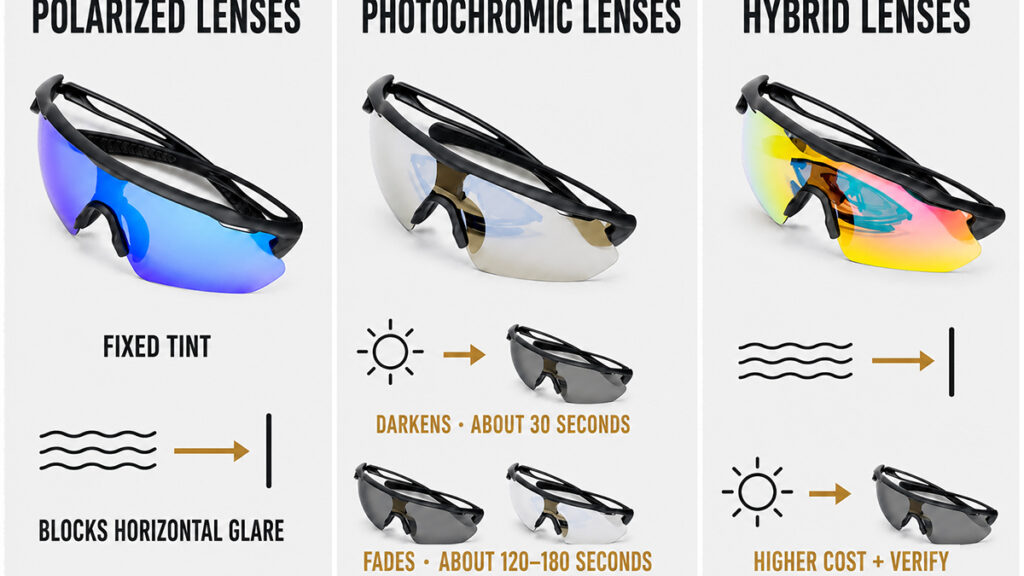
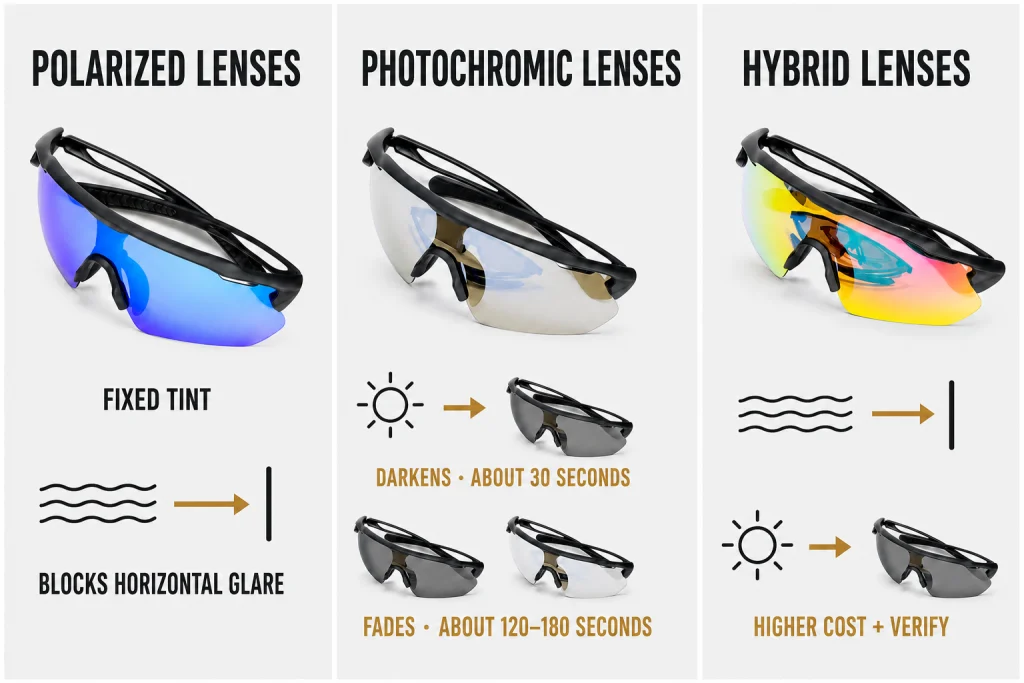
Polarization filters out horizontally reflected light (glare from asphalt, agua, car windows, caminos mojados). In product knowledge terms, polarized lenses typically operate in the 12–18% VLT range and are designed to reduce glare reflection. High-quality gray polarized lenses can achieve ≥99% polarization efficiency. They deliver a stable, high-contrast view in strong, consistent light but do not change tint with ambient conditions.
Fotocromático (light-adaptive) lentes
These lenses darken when exposed to UV and lighten when UV decreases. Typical VLT range is 15–80% (CAT 1–3). Transition speed from product data: approximately 3 seconds to darken; Roughly 3 seconds for full recovery. They are intended for full-day or multi-condition use where light levels change frequently.
Both technologies are available on PC lenses paired with TR90 frames —the standard combination for cycling sunglasses (ligero, flexible, impact-resistant frames with optional polarized or photochromic PC lenses).
2. Decision Criteria for OEM Brands
Use the following practical filters when specifying the lens for a new or refreshed cycling line.
| Decision Factor | Prefer Polarized | Prefer Photochromic | Consider Hybrid (Polarizado + Fotocromático) |
| Primary riding environment | Bright open roads, agua, high glare | Mixed light, forests, variable weather, all-day rides | Riders who want both glare control and auto-tint |
| Light consistency | Relatively stable strong light | Frequent light changes within a ride | Variable conditions with strong glare risk |
| Rider priority | Maximum glare reduction & contraste | Convenience of one pair for changing light | Premium versatility |
| Cost sensitivity | Lower incremental cost | Moderate incremental cost | Highest incremental cost |
| Optical stability | Fixed performance | Performance depends on UV/temperature | More complex validation needed |
| Typical price tier support | Mid to high | Mid to high | Mid-high to premium |
3. Performance Trade-offs Brands Must Understand
Polarized advantages for cycling
– Excellent reduction of road and surface glare.
– Stable visual performance—no waiting for the lens to adapt.
– High polarization efficiency (especially gray) improves contrast and reduces eye fatigue on long rides in bright conditions.
– Well-suited for road cycling, time trials, and any scenario with strong horizontal reflections.
Polarized limitations
– Fixed tint. In shaded sections, tunnels, or late-day rides the lens can feel too dark.
– Some riders report reduced visibility of certain LCD screens (bike computers, phones) depending on polarization axis.
– Does not adapt; multiple lens options or a second pair may still be needed for full versatility.
Photochromic advantages for cycling
– One pair covers a wider range of light conditions without changing lenses.
– Useful for rides that start in low light, pass through forests, and end in open sun, or for all-day events.
– Aligns with the “one frame, multiple conditions” preference many recreational and endurance riders express.
Photochromic limitations
– Transition is not instantaneous (darkening ~3 s; ).
– Performance can be affected by temperature and the amount of UV reaching the lens (helmet position or certain coatings can slow the reaction).
– Maximum darkness and minimum lightness have limits; extreme bright or very low light may still feel imperfect compared with a dedicated fixed lens.
– Polarization is usually weaker or absent unless a hybrid construction is used.
Hybrid (polarized photochromic) options
HB-535 Product data includes polarized-photochromic combinations.
These attempt to deliver both glare control and adaptive tint. They sit at a higher cost point and require careful sample validation. Brands targeting premium or “do-it-all” positioning often test this option, but it is not automatically superior for every price tier or riding style.
When evaluating hybrid lenses, specifically check:
– Optical clarity and polarization efficiency after the combined process
– Actual transition speed under realistic conditions (including helmet/visor obstruction)
– Impact resistance and coating adhesion of the finished lens
4. What to Confirm with Your Manufacturer Before Locking Specs
When requesting samples or quotations, ask for and verify:
– Actual VLT range and polarization efficiency (especially for gray).
– Measured transition times under realistic UV and temperature conditions.
– Whether the photochromic or hybrid lens maintains optical quality and impact resistance after the coating/process.
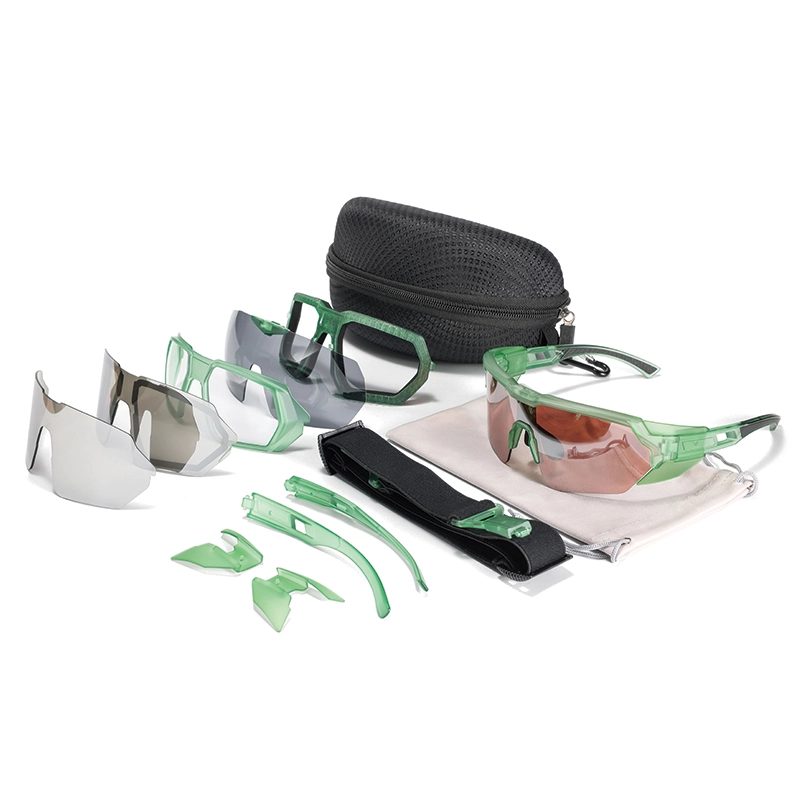
– Compatibility with the intended TR90 frame and any interchangeable-lens system.
– QC checks that will be performed (polarization test, UV400, impact, coating adhesion).
– Exact cost difference and any MOQ impact of polarized vs photochromic vs hybrid (these must be confirmed on the specific quotation).
TR90 frames remain the practical default for cycling sunglasses because of their low weight, flexibilidad, and impact resistance. Lens choice should be evaluated on the finished sample, not only on data sheets.
5. Common Mistakes Brands Make
– Choosing photochromic solely because it sounds more advanced, without testing transition speed and final darkness on real rides.
– Specifying polarized without considering that some riders need a second, lighter lens for mixed conditions.
– Treating hybrid as a default “best of both” without validating cost, actuación, and optical quality on samples.
– Ignoring how helmet position, visors, or specific coatings can affect photochromic reaction.
– Locking a single lens technology for an entire line when the target riders have clearly different primary use cases.
Conclusion and Next Step
Polarized and photochromic lenses solve different problems. Polarized prioritizes glare control and optical stability in bright, reflective conditions. Photochromic prioritizes convenience across changing light. Hybrid options exist for brands that want both and are willing to accept higher cost and more rigorous sample validation.
For most OEM cycling sunglasses projects, the cleanest approach is:
1. Define the primary rider and primary riding environment.
2. Choose the lens technology that best matches that environment.
3. Validate with real samples under relevant light and temperature conditions.
4. Decide whether a single technology, dual options via interchangeable lenses, or a hybrid construction best fits the brand’s price and positioning goals.
Recommended next action:
Request three finished samples on the same TR90 frame platform:
1. High-quality polarized
2. Fotocromático
3. Hybrid (polarizado + fotocromático), if considering the premium option
Direct side-by-side comparison under actual riding light conditions remains the fastest way to make a confident decision.