Picking the wrong factory doesn’t hurt you on unit price. It hurts you when you miss the season, when the optics are off and riders complain of eye strain, or when a container sits at customs because the compliance paperwork doesn’t hold up.
We have been in the sports eyewear business for sixteen years, and every month we receive numerous inquiries from buyers in Europe and the U.S.; one can tell at a glance the difference between those who know exactly what they want and those who are just casting a wide, vague net.
So this isn’t another buyer’s framework for vetting suppliers — plenty of those already exist. I’m writing from the other side of the audit: here’s what buyers should actually push us on, our real answers, the numbers you can verify yourself, and the things we can’t do. Take this list to any factory and it should surface something real.
1. Primero, confirm you’re actually talking to the factory
This goes first, because if the answer is no, every test report that follows may not be theirs.
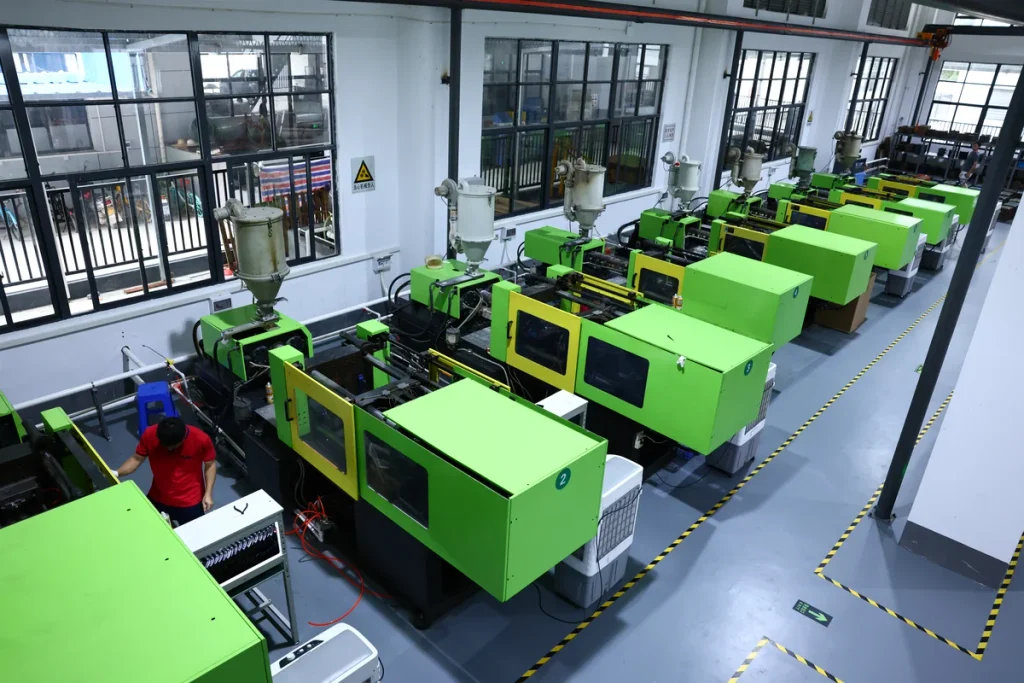
Don’t bother with a scanned business license. Ask them to open a video call and walk the camera from the injection molding machine, through the coating room, to the assembly line — one take, no cuts. A trading company can’t make that walk.
Our address is 3/4F, No.3, Yongfu st, Sandong rd, Pueblo de Xinhua, Distrito de Huadu, Guangzhou, Provincia de Guangdong, China.。Encima 10,000 m² of dust-free workshop across 3 factories and 12 production lines, 150+ workers, 150,000+ units a month. Video tour any time, or come see it.
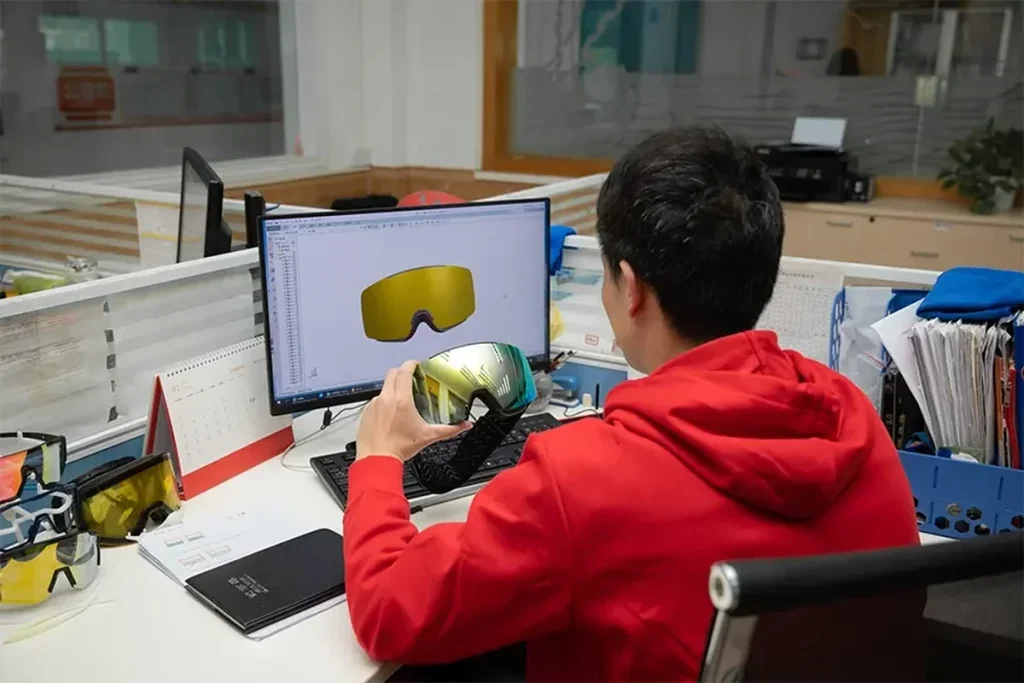
Then push on one more thing: who holds the mold for this frame? Some suppliers take the order and farm it out. When the tooling sits in someone else’s shop, adjusting a nose-pad angle means waiting for their machine time. Our 8-person R&D team and 120+ design patents run on tooling we own
The business license scope is worth a look too. A real manufacturer lists eyewear manufacturing and sports protective gear production. A pure trading company usually lists only wholesale, retail, and import/export.
2. On certifications, how you ask beats whether they have them
“We have CE, FDA, and ANSI.” Nearly every factory says this, and it carries almost no information. Three things matter: who issued it, when, and which model it covers.
Here’s what we can put on the table:
| Proceso de dar un título | Issuer / number | Status | What it tests |
| CE (sunglasses ISO 12312-1; goggles EN 166/167/174) | Intertek | Valid 2024–2026 | Optical quality, impact, corrosion, flammability, ultravioleta |
| ANSI Z80.3-2018 | Intertek, model HB-507A | Valid | Optics, ultravioleta, drop ball (5/8″ steel ball from 127 cm) |
| ANSI Z87.1-2025, Z87+ rating | Intertek, 16 de 16 samples passed | Valid | Drop ball, 500 g pointed impact, 164 km/h steel ball, needle penetration |
| FDA facility registration | Registration no. 3012788416 | Valid FY2026 | Registration and device listing — not a test |
| ISO 9001 | First certified 2015 | Valid for 2025 | Doesn’t test product; audits incoming material through complaint closure |
| ISO 14001 | — | Valid | Environmental management |
| RoHS | NAP testing, 120+ modelos | All N.D. | 10 restricted substances |
| GRS V4.0 | Bureau Veritas, cert. BVC-TE-00336345 | Through 2027-05-11 | Recycled TPU / ordenador personal / nylon / PU |
| BSCI social audit | TÜV Rheinland, audited 2025-07-28 | Through 2026-08-04 | Labor, working hours, seguridad, environment |
One trap worth stating plainly: a GRS scope certificate is not shipment proof. Our BVC-TE-00336345 only shows this line is approved to run recycled material. Every shipment still needs its own TC (Transaction Certificate). If your customer is a German or Nordic retailer, the TC is what gets audited — not the scope certificate. Some factories wave the scope certificate around as “we’re GRS certified,” and it surfaces at customs or during a retail audit.
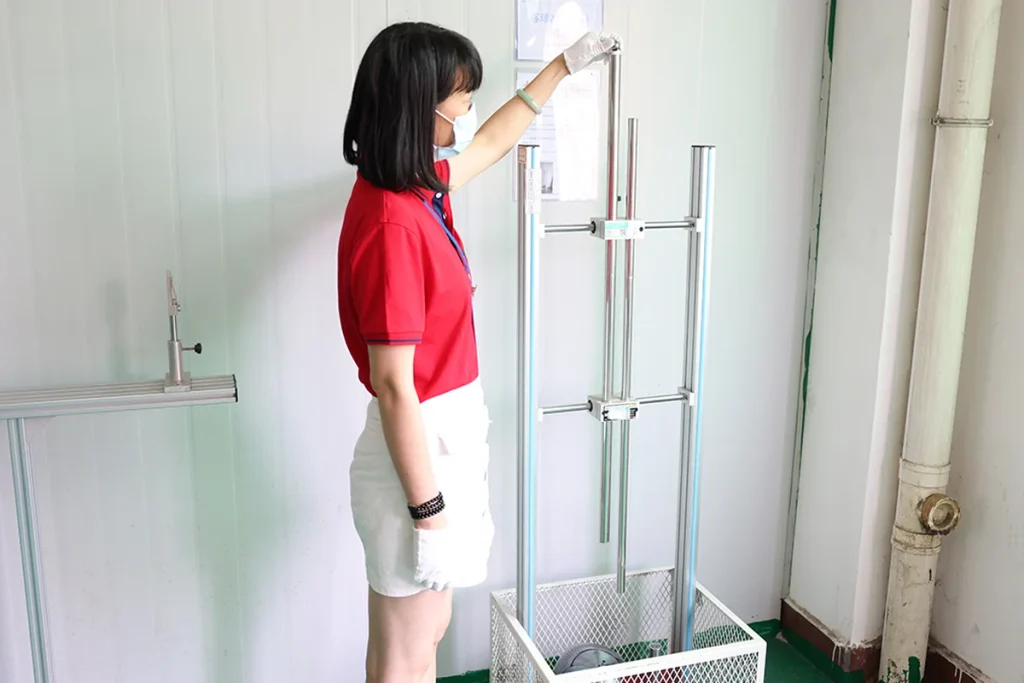
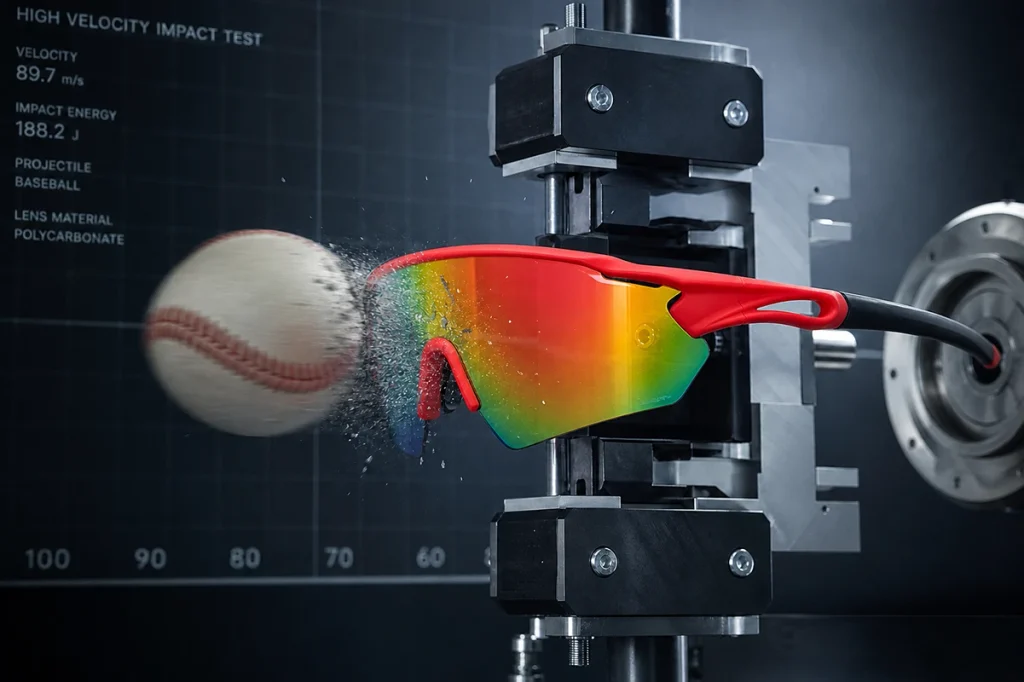
Impact test bench:
Audit note: Don’t settle for a PDF screenshot. The certificate number should be searchable on the issuer’s own site — Intertek, SGS, Bureau Veritas, and the FDA all have public lookups. Backdated expired certificates and certificates borrowed from another factory both happen.
Z87.1 deserves a note too. It isn’t the sunglasses-grade drop ball — it’s a 500 g pointed impact, a 164 km/h steel ball, and needle penetration. Road debris never reaches that energy. So if a factory can’t produce even a Z80.3 drop-ball report and just tells you their PC lenses are tough, you can end the conversation.
What to ask for: a UV transmittance report for every tint you’re ordering, an impact report dated within 12 months, and model numbers on the report that match your PO. Tints use different dye formulations — one grey-lens report doesn’t cover a yellow lens.
One more: the applicant name on the report should match the business license. A certificate number you can look up on the issuer’s own site is the only kind that counts. Our FDA registration 3012788416 is searchable yourself.
3. Lens specs have to be numbers
Most of the price spread in cycling eyewear sits in the lens, no el marco. Which means quotes are only comparable if the lens is pinned down.
Our measured ranges:
- Polarizado (TAC): grey polarized runs ≥99% efficiency. Light tints — yellow, rosa, purple — are low-polarization at 70–85%, roughly CAT.1. Some suppliers price a light low-pol lens like a grey one. It’s checkable. Ask for polarization efficiency data.
- Fotocromático: darkens in about 30 seconds; clears to roughly 85% en 120 seconds, fully by 180. That difference is very visible on a ride — it’s the few seconds coming out of a tunnel.
- HD high-contrast: 12–50% VLT. Filters visual noise; mostly cycling and off-road.
- REVO mirror coating: 8–18% VLT, for bright light and water glare.
Lens thickness runs 1.0–2.0 mm depending on model and function. Base material is PC, TAC, or nylon (PA). UV400 across the range. Anti-fog tested to EN ISO 18527-1:2022, and cylindrical models can be done with IMD in-mold anti-fog.
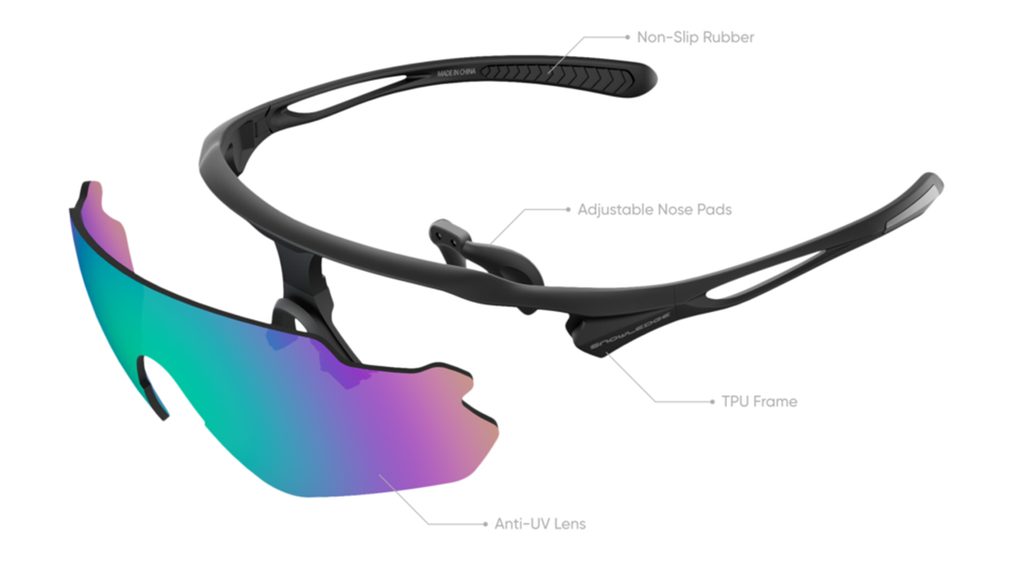
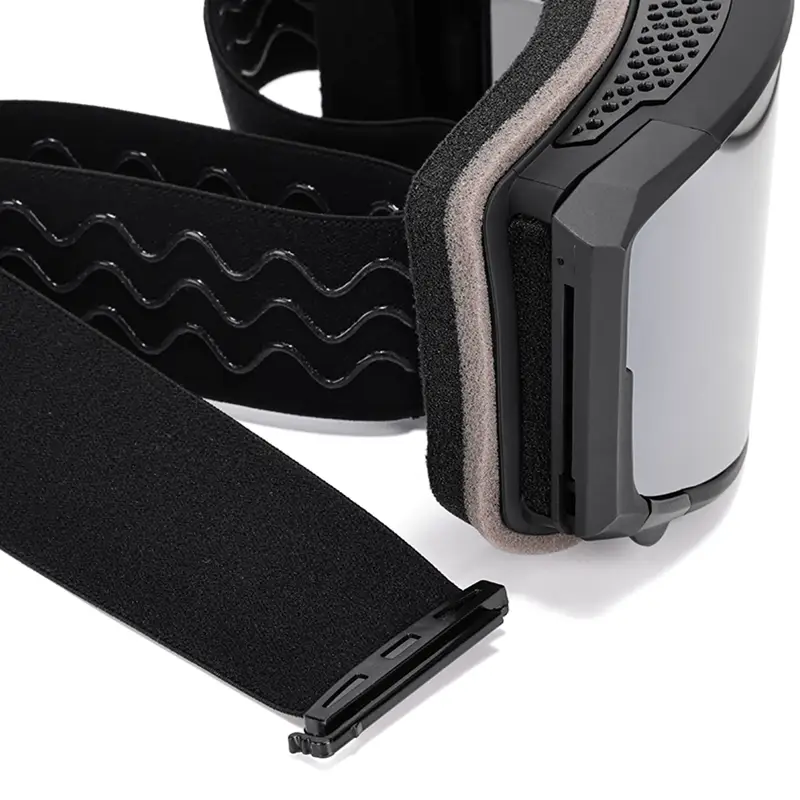
On frames: TR90 complete glasses at 35–40 g, lightweight versions down to 30 gramo, and our classic cylindrical series has hit 26 gramo. Cupronickel spring hinges with 304 stainless screws — the two parts most easily swapped for plain steel, and a salt spray test exposes it immediately. So ask about hinge and screw material specifically. TPE nose and temple pads, rubberized non-slip temples, 5-second lens swap.
What to ask for: polarization efficiency, VLT, and photochromic transition times written into the quotation — not just the words “polarized lens.” If they can’t put numbers in writing, they don’t know them either.
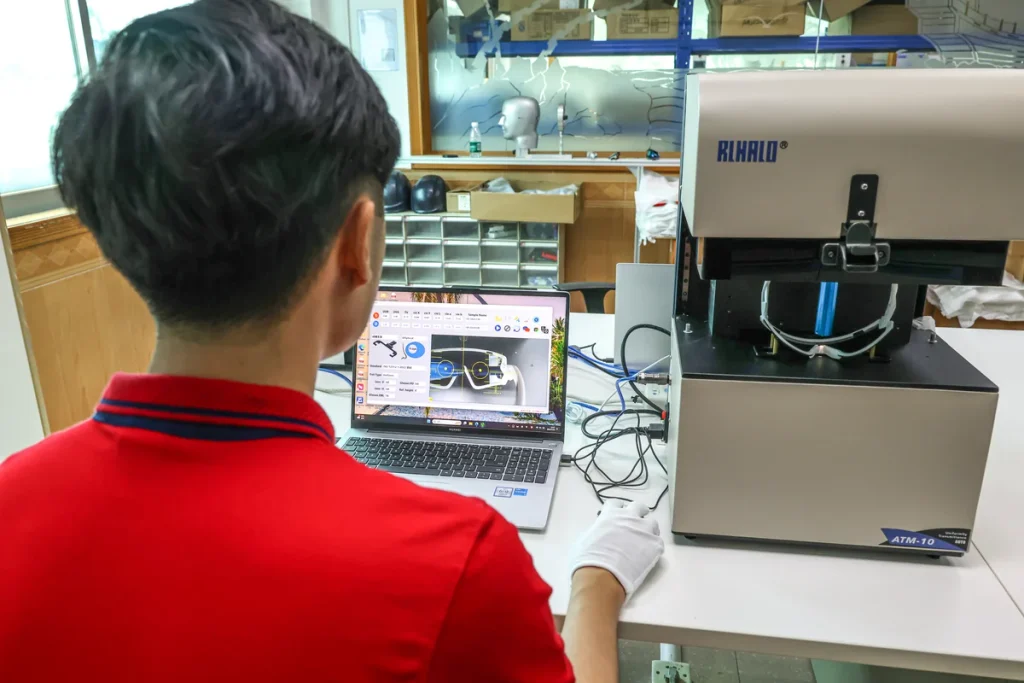
Spectrophotometer: verifying UV400 cutoff, polarization efficiency, and VLT — measured per tint, not once per range.
4. Ask MOQ per color, not per model
The most misread line on any quotation. The factory writes “MOQ 300,” the buyer assumes 300 pairs starts production, and then scheduling reveals it’s 300 per color.
Ours break down separately:
- Lens colors: minimum 100 pieces per color
- Frame colors: minimum 300 pairs per color
So four frame colorways puts your floor at 1,200 pairs, no 300. For a new line that’s a real difference, and it’s worth asking at the RFQ stage.
The above is for reference only. If you have more complex needs, you can get free consultation at any time.
Contract note: If you’re paying for exclusive private tooling, put mold ownership in the agreement — title stays with you, and the factory can’t run that tooling for anyone else without your written consent. It’s one sentence at negotiation and very hard to add later.
5. Ask for a lead time range, and pull sample approval out separately
The most common distortion in a quoted lead time: sample approval sits outside it, and nobody mentions that at quoting.
Delivery time:Our standard lead time for bulk orders is 35 días; we also offer an expedited 15-day delivery option!
Sample approval time is additional. Design drafts in 1 hora, samples with your logo in 7 días. But your internal review, one round of curvature changes, then sign-off usually takes longer than the sampling.
If the order is tied to a dated window — spring season on shelf, team kit before race day — don’t accept “about four to five weeks.” Get dated milestones: sample sign-off, color and quantity lock, bulk start, in-line QC, final inspection, factory handoff, vessel departure. A date on each.
Peak season stretches scheduling. Twenty thousand pairs ordered in November and the same order in March are not the same lead time.
6. Inspection can’t start at the finished product
Pre-shipment inspection is the floor, but final-inspection-only is already too late. When lens coating goes wrong, the whole batch is built by the time anyone catches it.
We check at three points: incoming material (lens base, bisagras, screws), in-line during coating and molding, and final pre-shipment. Quality management runs on ISO 9001, from incoming goods through complaint closure. Standard QC covers polarization efficiency, UV400, impact, and salt spray.
One packaging number you can drop straight into freight math: one pair into a film or pearl-cotton bag, into an inner box, into an export carton at 55×45×58 cm, roughly 18 kg per carton. For ocean volumetric weight that’s far more useful than “standard export carton.” One buyer’s published sourcing account makes the point well — a badly designed carton added 15% volume on the ocean leg and turned a quote that looked 13% cheaper into a higher landed cost.
After-sales: 1-year warranty, free replacement of defective units, support points in China and the US, complaints answered within 24 hours with a plan inside 48. Routine messages within 2 horas.
What to ask for: production-line samples, not sample-room units. Sample-room pairs are hand-assembled. Production pairs are what you’ll actually receive. Twenty to thirty is enough to judge consistency.
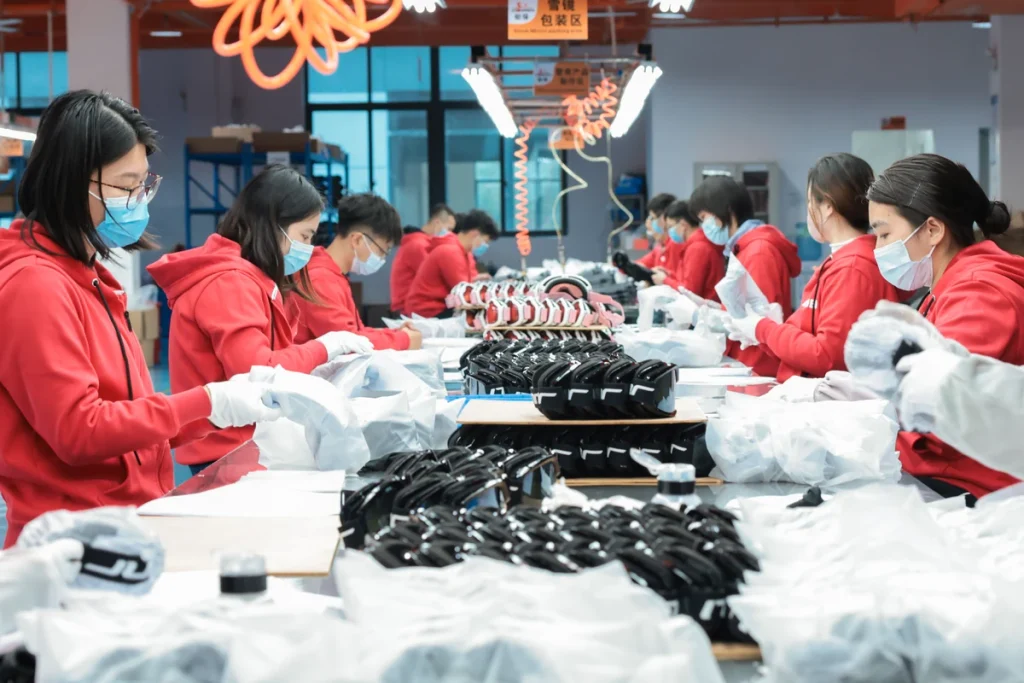
Pre-shipment check: bisagras, screws, and coating, re-verified after salt spray testing.
Sealed sample note: Once the pre-production sample is approved, both sides should seal an identical pair and the PO should name it as the acceptance benchmark for the bulk run. When a batch drifts, that sealed pair is the only thing that settles the argument.
Preguntas frecuentes
Can I start with just 300 pairs?
Yes — one model, one color, 300 pairs starts production. But multiple colorways run against the per-color minimums above, so your real total goes up.
How do I confirm the reports are yours and not borrowed?
Check the factory name and address on the report against the business license, then match the model number. Our ANSI Z87.1 is from Intertek, 16 de 16 passing at Z87+. FDA registration 3012788416 is searchable on the FDA site. GRS certificate BVC-TE-00336345 is verifiable with Bureau Veritas. Numbers you can check yourself are the only ones that count.
Can photochromic and polarization go in the same lens?
Yes — we make a combined photochromic + polarizado + light-diffusing lens. Cost and lead time both run higher than single-function, so confirm your retail price supports it first.
How are sample fees handled?
7-day sampling including your logo. The fee depends on the style and whether new tooling is needed. Whether it’s creditable against the bulk order varies by factory — get it in writing before you order.
Photochromic or polarized for cycling?
Open road in daylight, polarized wins — it kills the horizontal glare off asphalt and standing water. Changing light on forest singletrack, or a ride from dawn into dusk, favors photochromic, which adjusts transmission to UV intensity. Ours darkens in about 30 seconds and clears fully in about 180, and that response time is what decides whether it works on a tree-lined trail.
If you want to verify any of this
Everything above is open: original certificates, test reports, line video, production samples.
- Correo electrónico: info@julong.com
- WhatsApp: +86 134 5028 4642
- Products and customization: julongeyewear.com/solutions
- Direct contact: julongeyewear.com/contact-us
For samples, tell us three things — ride type (road, gravel, Mtb, commuter, triathlon), lens grade, and target quantity. With those three we can quote a number you can actually compare against someone else’s.