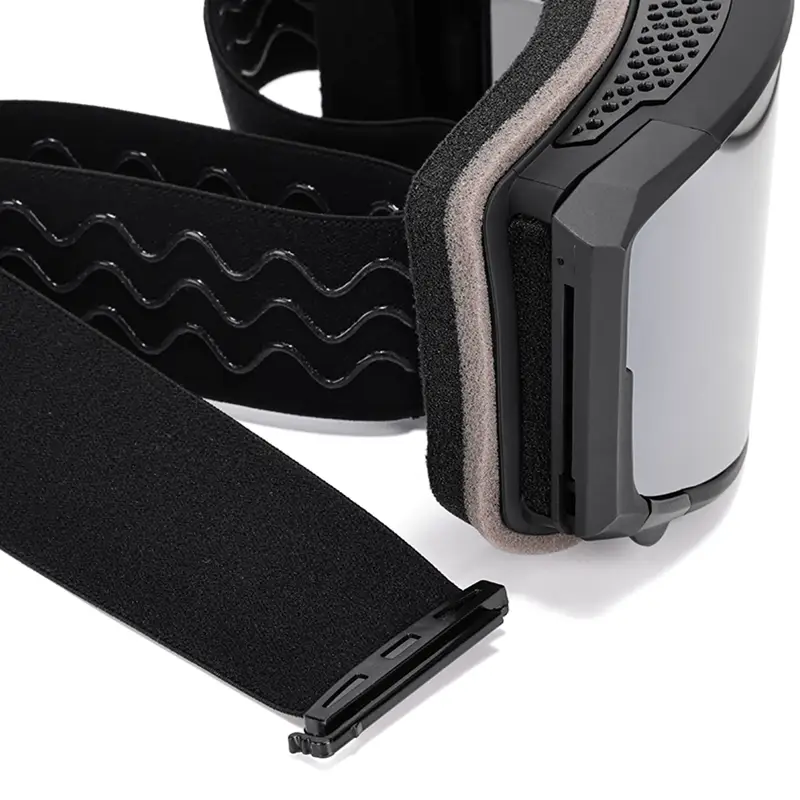
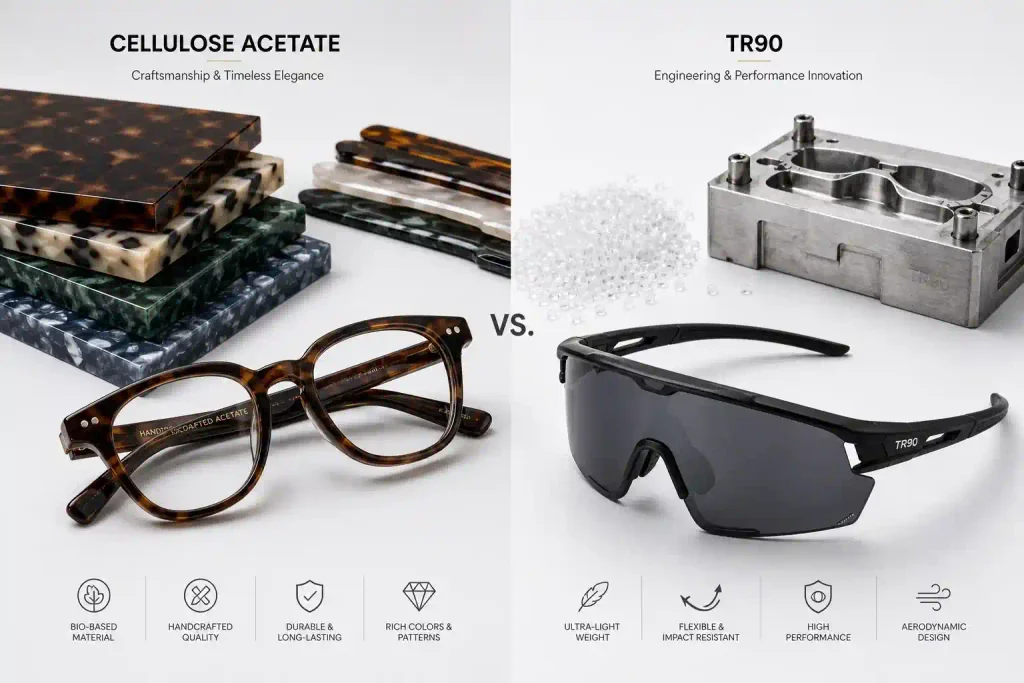
Acetate and TR90 sit in similar price brackets and are both found across mid-to-premium eyewear lines. But their design logic is fundamentally different. Acetate is a craft material shaped from sheet stock — it prioritizes visual depth and brand character. TR90 is an engineered thermoplastic built for performance — it prioritizes weight, flexibility, and durability under physical stress.
Choosing between them is not a question of which is better overall. It is a question of which fits the product you are building, the athlete you are designing for, and the market you are selling into.
1. What Are Acetate and TR90?
アセテートフレーム
Cellulose acetate is derived from natural raw materials — cotton pulp or wood pulp — processed into rigid sheet stock. Frames are cut, milled, and hand-finished from these sheets, which allows for a distinctive depth of color, layered patterns, and a surface quality that is difficult to replicate with injection molding.
The manufacturing process is slower and more labor-intensive than injection molding. Each frame passes through multiple hand-finishing and polishing stages. This is reflected in both the visual output and the production cost.
Acetate’s natural origin also gives it two properties that synthetic frames cannot match: it is inherently hypoallergenic — an important consideration for brands targeting customers with sensitive skin — and it originates from renewable, partially biodegradable plant-based materials, which supports ESG positioning in markets where sustainability credentials matter.
Acetate has genuine limitations in sports contexts. It is denser than most engineering plastics. It is moderately susceptible to heat — prolonged exposure to high temperatures can cause warping. And while it can be engineered to flex, it does not have the elastic memory of TR90, meaning it is less forgiving under the stresses of active use. One practical upside of acetate’s thermoplastic nature: trained opticians can heat-adjust the temples and nose bridge to fit individual wearers — useful for brands that offer post-sale fitting services.
TR90 フレーム
TR90 is a thermoplastic polyamide elastomer, injection-molded into its final form in a single production step. Its defining properties are low density (approximately 20% lighter than acetate), high elastic recovery — meaning the frame returns to its original shape after bending — and strong resistance to impact, 汗, and UV exposure.
TR90 was adopted by the sports eyewear industry precisely because it handles the conditions that acetate cannot: repeated flexion from helmet and strap use, sweat and water contact during long activities, and the occasional impact or fall.
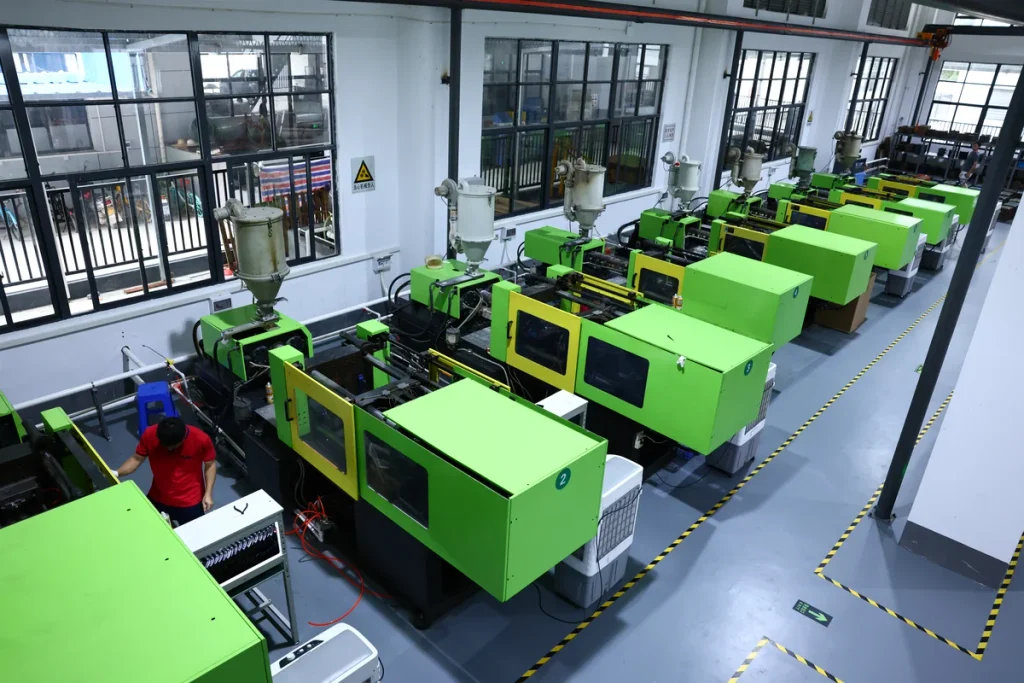
The injection molding process makes TR90 significantly more scalable than acetate. Tooling costs are higher upfront, but per-unit production costs drop substantially at volume.
Sustainability note: Standard TR90 is a synthetic polymer — industrially recyclable but not biodegradable. For brands with ESG requirements, bio-based TR90 (derived from plant-based feedstocks) is now available as an alternative, offering equivalent mechanical performance with a significantly reduced carbon footprint. Julong offers bio-based TR90 as an optional material upgrade for OEM orders.
2. Head-to-Head Comparison
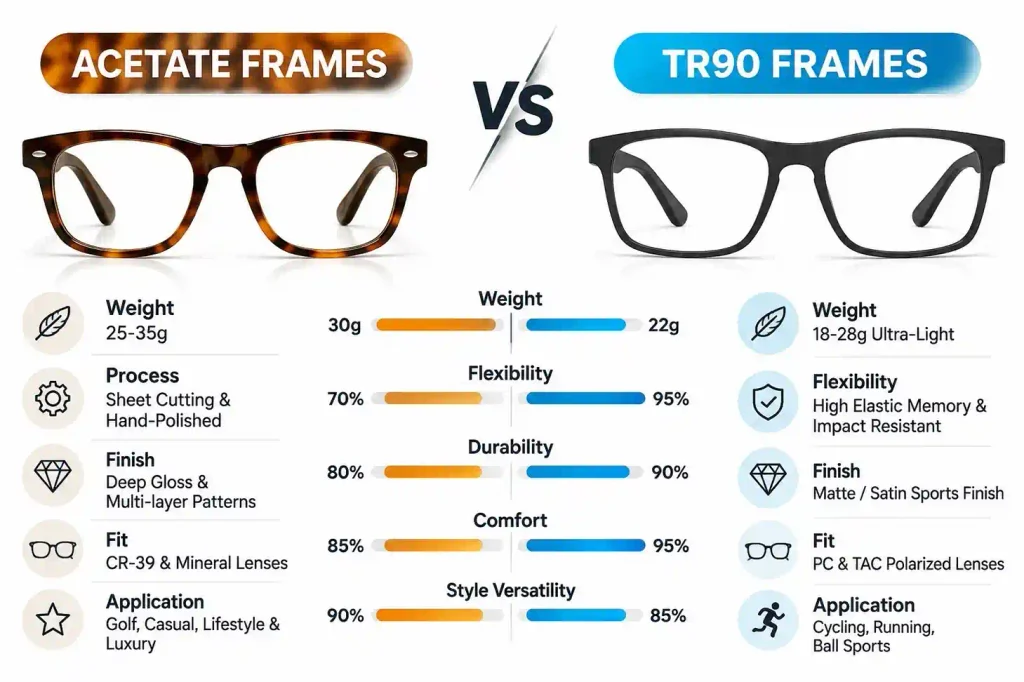
| 財産 | アセテート | TR90 |
| Frame weight | 25–35g | 18–24g (frame only) |
| Complete eyewear weight | 30–45g | approx. 26–32g |
| 柔軟性 | Limited; heat-sensitive | High elastic recovery; 耐衝撃性 |
| Visual quality | Deep color, high gloss, layered patterns | Primarily matte/satin finishes |
| Water & 耐汗性 | 適度 | 素晴らしい |
| 低刺激性 | はい (plant-based cellulose) | Generally yes; depends on grade |
| Sustainability | Renewable source; partially biodegradable | Synthetic; bio-based variant available |
| Manufacturing process | Sheet cutting + hand finishing | Injection molding |
| Color customization | Extensive (sheet layering) | Good range; limited layering effects |
| Lens compatibility | CR-39, mineral, optical-quality lenses | パソコン, TAC, NXT — standard sports lens materials |
| Impact certification | Not standard for sports use | ANSI Z87.1 / EN 166 tested (sports frames) |
| Unit price | より高い | Mid-range |
| OEM MOQ | Typically higher | More flexible |
What the numbers mean in practice: The 7–10g weight difference is significant for a product worn for 2–4 hours during cycling, 走っている, or trail activity. At the same time, acetate’s visual depth — the way color sits inside the material rather than on its surface — is something TR90 cannot replicate, regardless of the finish applied.
3. Sports Performance: Where Each Material Wins

Where TR90 Excels
TR90 handles the conditions that define most sports use cases.
Cycling and running: Extended wear, sweat contact, UV exposure, and the occasional impact or crash are all part of the category. TR90’s elastic recovery means the frame holds its geometry after being stuffed into a jersey pocket or compressed under a helmet. Its water and sweat resistance means the nose pads and temple tips maintain grip rather than becoming slippery.
Ball sports and court sports: 野球, cricket, and padel place specific demands on eyewear — the frame needs to stay in place during rapid direction changes and absorb occasional ball or elbow contact without shattering. TR90 handles both.
High-heat environments: TR90 maintains its shape in a hot car, a beach bag, or summer training conditions where temperatures can exceed 50°C. Acetate begins to soften above approximately 60–70°C under sustained pressure.
Where Acetate Has a Role
Acetate is not a performance material for high-impact sports. Its appropriate context in sports-adjacent eyewear is defined by style priority over technical performance:
Golf: A sport where the aesthetic of the equipment carries brand meaning, and where the demands on the frame — no sweat resistance, no crash survival, no helmet compatibility — are limited to UV protection and comfortable wear over 3–4 hours.
釣り: Similar logic. Acetate fishing frames can pair well with high-quality polarized lenses, and the aesthetic of the frame communicates quality to the buyer.
Lifestyle and fashion-sport crossover: When the product is as much about being seen as it is about performance, acetate’s material character becomes a differentiator.
4. Lens Compatibility and Frame Construction
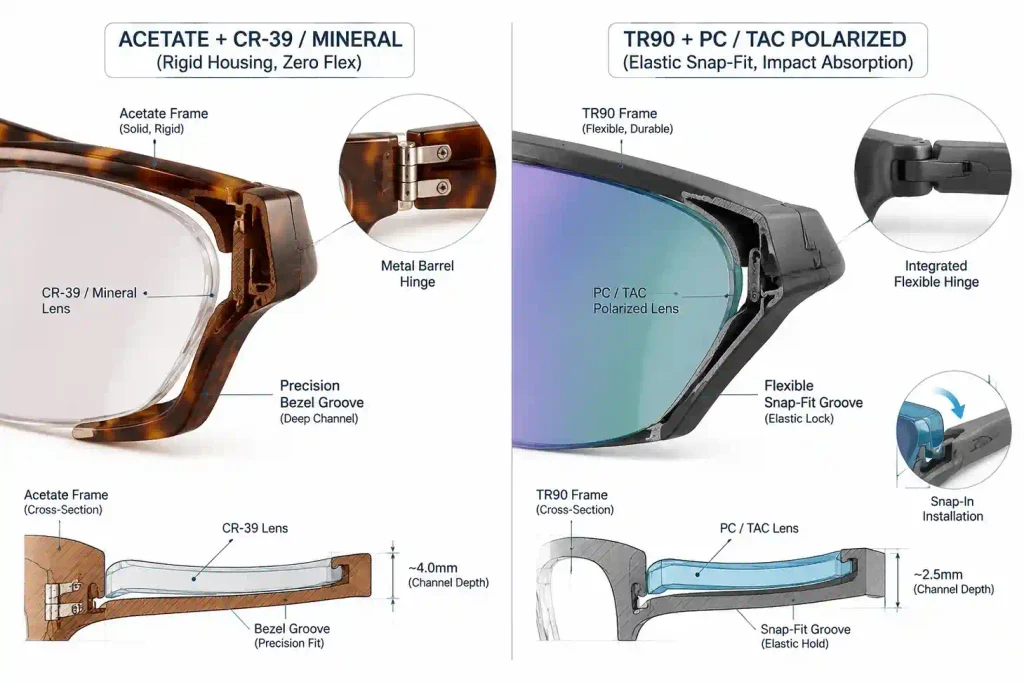
The frame material determines which lens materials work well and which mounting methods are available.
Acetate frames are typically fitted with CR-39 organic lenses or higher-index mineral lenses. The rigidity of acetate creates a stable housing for precision optical lenses — it does not flex during mounting in ways that could stress the lens. This makes acetate frames a natural choice for prescription optical and premium polarized lenses where distortion tolerance is tight.
TR90フレーム are designed to work with PC (ポリカーボネート), TAC (triacetate cellulose), and NXT/Trivex lenses. These are the standard lens materials for sports eyewear — lighter, more impact-resistant, and tolerant of the slight flex that TR90 frames undergo during active use. The flexibility of TR90 is an asset during lens installation, allowing for a secure snap-fit that would crack a more rigid frame.
Hinge design implications: Acetate frames commonly use metal barrel hinges set into the frame material. TR90 frames at Julong use white copper spring hinges with 304 stainless steel screws — a construction detail that significantly reduces hinge fatigue compared to standard brass fittings, and maintains frame geometry under the repeated stress of sports use.
Polarized lens mounting: Both frame types can carry polarized lenses, but the mounting precision matters more with TR90. Because TR90 flexes slightly in wear, the polarized film within a TAC lens must be aligned and seated firmly to prevent any shift in polarization axis during use.
5. OEM Customization and Cost
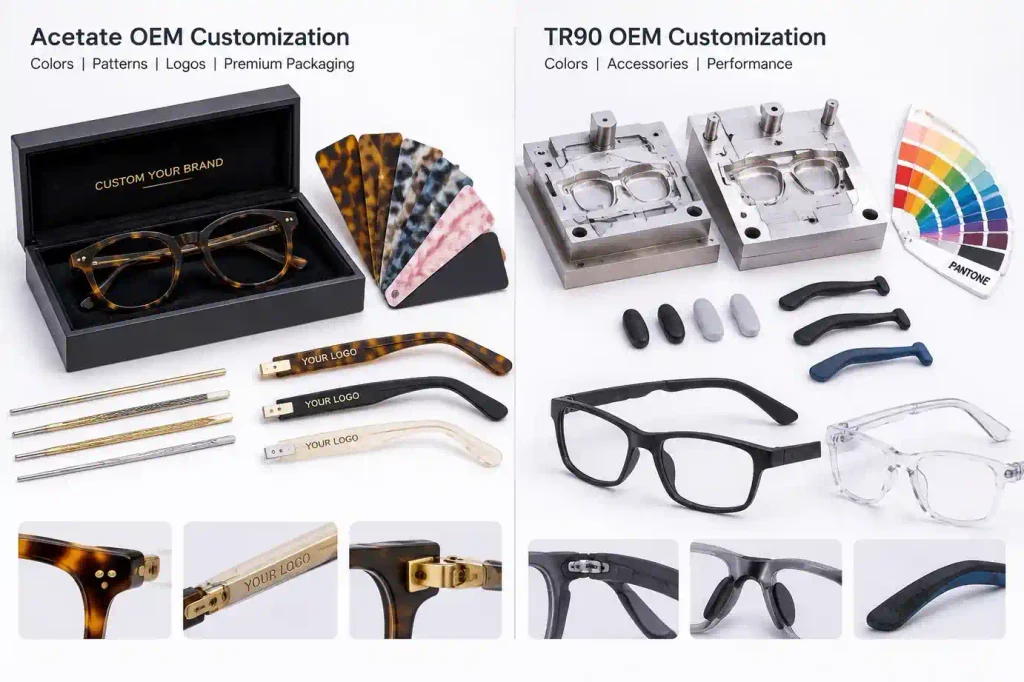
Acetate OEM
The primary customization advantage of acetate is visual: sheet layering creates color depth and pattern variation that injection molding cannot match. Logo engraving or laser etching on acetate has a premium tactile quality. For brands building a product that needs to communicate craft and heritage at the retail shelf or in an unboxing moment, acetate delivers a signal that TR90 does not.
The constraints are cost and minimum order quantity. Acetate sheet preparation, CNC cutting, and multi-stage hand finishing mean that production runs below 300–500 units per SKU are rarely cost-effective unless the brand can command a retail price that justifies the per-unit cost.
Lead times are also longer — a typical acetate OEM run from confirmed order to finished goods runs 45–70 days, depending on complexity.
TR90 OEM
TR90’s tooling-to-production workflow is faster and more scalable. Once molds are cut and sampling approved, production quantities from 200 units per SKU are viable. Color customization is done in the material itself during injection, meaning consistent color throughout the frame cross-section — no surface chipping exposes a different color underneath.
Rubber or TPE nose pads and temple tips can be co-molded or added as separate components, giving significant functional customization options without adding complexity to the production process. そしてジュロン, TR90 frames ship with TPE nose pads (silicone available on select models), white copper spring hinges, そして 304 stainless steel screws as standard — hardware specs that OEM buyers should confirm are included in any factory quotation.
Bio-based TR90 option: For brands with sustainability requirements, Julong offers bio-based TR90 as an upgrade. Performance and processing are equivalent to standard TR90; the difference is in the feedstock origin, which supports lower lifecycle carbon claims and helps brands meet EU ESG disclosure requirements.
Lead times for TR90 runs typically run 30–45 days after mold approval.
Cost Comparison
| Order Volume | Acetate Cost Position | TR90 Cost Position |
| Sample / 50 単位 | High per-unit cost | Moderate per-unit cost |
| 200–500 units | 高い | Competitive |
| 1,000+ 単位 | 適度 (amortized tooling) | Low to moderate |
The crossover point varies by design complexity, but TR90 is typically 25–40% lower cost per unit at comparable volumes for straightforward sports frame designs.
6. How to Choose: A Decision Guide for Brands and Buyers
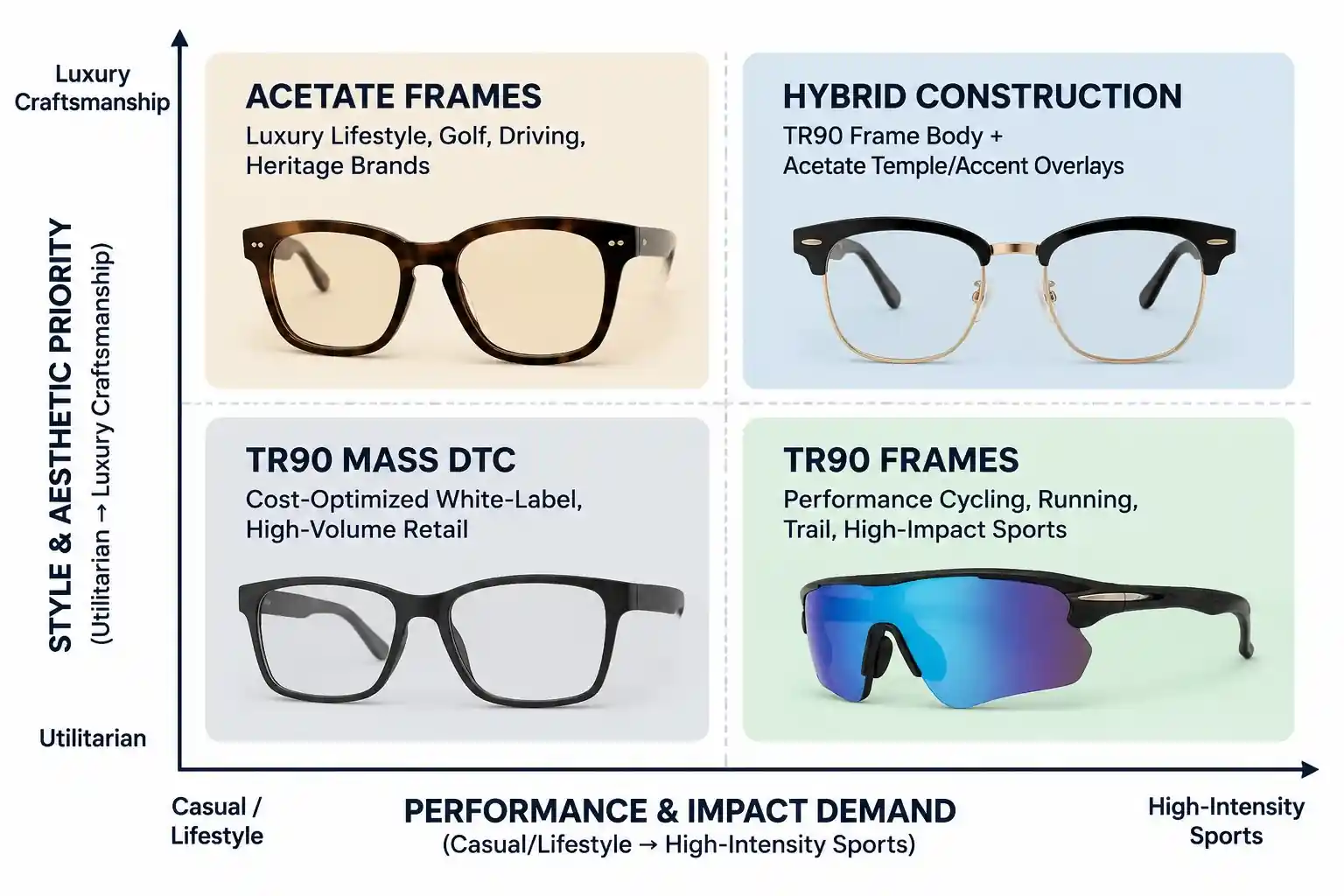
The right material depends on three factors: who the product is for, what they will do in it, and what the brand needs to communicate.
| Brand / Product Profile | Recommended Material |
| Performance sports brand (サイクリング, 走っている, trail) | TR90 |
| Premium lifestyle / fashion-sport crossover | アセテート |
| Mass-market DTC sports retail | TR90 |
| High-end gifting / corporate customization | アセテート |
| OEM white-label (cost-optimized) | TR90 |
| Dual-line brand (パフォーマンス + lifestyle) | TR90 (performance line) + アセテート (premium line) |
A note on mixed-material construction: Some brands use TR90 for the primary frame structure — temples, bridge, and lens housing — and acetate for decorative overlays or end tips. This approach captures TR90’s weight and durability advantage while adding acetate’s visual character at a lower cost than a full acetate frame. It is worth exploring with your factory if you are targeting the premium sports segment without committing to full acetate production costs.
Compliance note for TR90 sports frames: Julong TR90 sports frames are tested to ANSI Z87.1-2025 (耐衝撃性) and ANSI Z80.3-2018 (optical quality) 標準, with UV400 protection across all lens configurations. For export to the EU, CE marking under EN ISO 12312-1 is available. OEM buyers should request the relevant test certificates as part of product documentation — these are requirements, not optional extras, for selling into the US and European markets.